Do You Really Need Fiber? What the Evidence Actually Says
There is one piece of diet advice so universal that almost nobody stops to question it. Eat more fiber. It is on the cereal box, in the doctor's office, on the side of the bread bag. Whole grains, bran, "keeps you regular," "feeds your gut." It is treated less like a suggestion and more like a law of nature.
So let me ask the question out loud, the one that sounds almost rude: do you actually need it? Not "is fiber found in healthy foods," but the harder question underneath. Is fiber itself a requirement, a nutrient your body cannot do without, the way it cannot do without protein or vitamin C? Or is it something we have simply repeated so many times that it stopped needing evidence?
I went looking for the evidence. I also, as it happens, ran the experiment on myself. Here is the honest version of both.
One species, every possible fiber intake
Start with the widest possible view, because it settles more than people expect.
If fiber were a true human requirement, you would expect a fairly narrow range of intake across healthy human populations, the way there is a fairly narrow range for the things we genuinely need. That is not what the record shows. Humans have been robustly healthy across almost the entire possible spectrum of fiber intake.
At one end sit the traditional meat-eating cultures. The Plains hunters, the far-northern peoples who lived much of the year on animals and almost nothing that grows, ate close to zero fiber for long stretches and did not fall apart. At the other end sit hunter-gatherers like the Hadza of Tanzania, whose fiber intake dwarfs anything a modern nutritionist would dare recommend, many times the Western average, and it swings dramatically with the seasons as the available plants change. Researchers who tracked the Hadza gut microbiome watched it cycle up and down across the year in step with that changing diet.
Sit those two facts next to each other. One group thrives near zero. Another thrives in the triple digits. A nutrient that a species can flourish almost entirely without, and also flourish while eating enormous amounts of, is not behaving like a requirement. It is behaving like a variable.
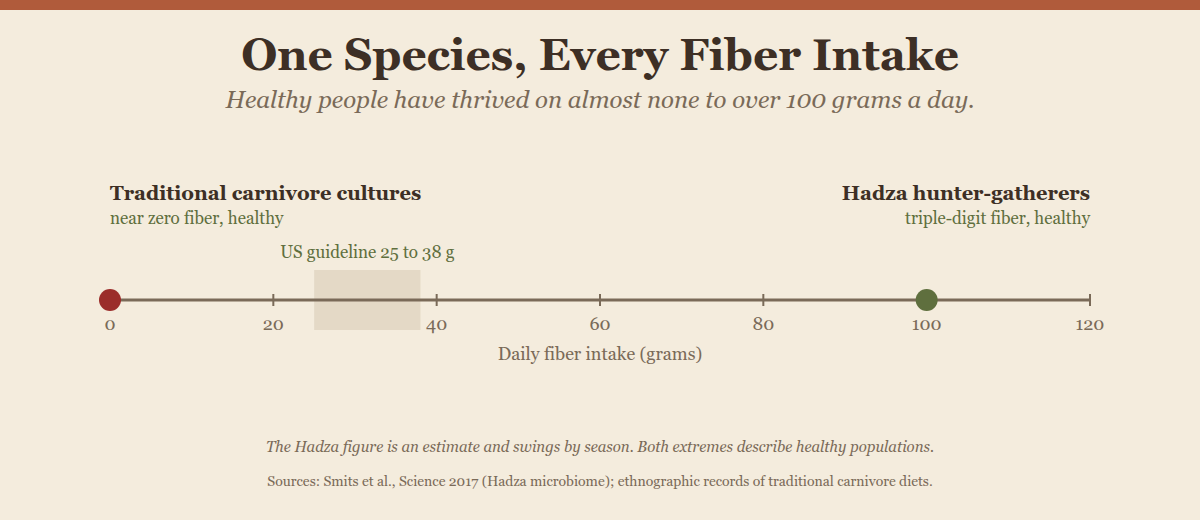
That is the first crack in the wall, and it is worth holding onto as we go: whatever fiber is, it is not something the human body must have to function. We have the living proof at both extremes.
Where the number actually came from
So where did "25 to 38 grams a day" come from, if not from a deficiency the way we found vitamin C by watching sailors get scurvy?
It came, in large part, from an observation. In the 1960s and 70s, an Irish surgeon named Denis Burkitt noticed that rural Africans eating high-fiber traditional diets rarely suffered the bowel diseases filling Western hospitals: constipation, diverticulosis, colon cancer. He proposed that the fiber was the protective difference. It was a reasonable hypothesis, and it was genuinely influential. It is essentially the seed of every fiber message you have heard since.
But notice what it was: a correlation between whole, traditional, unprocessed eating and good health, with fiber nominated as the hero. Those rural diets differed from the Western one in a hundred ways at once. Less sugar. No industrial food. More movement. Fiber was one variable among many, and it got the credit for all of them. That is not a knock on Burkitt, who was a careful man asking a good question. It is a caution about how a hypothesis hardens into a commandment before the test results are in.
The strongest case for fiber, stated fairly
I am not going to wave away the evidence that fiber looks good. Applying one honest standard means saying plainly when the other side has real data, and here it does.
The largest modern synthesis, Reynolds and colleagues in the Lancet in 2019, pooled decades of studies and found that people who ate the most fiber had roughly 15 to 30 percent lower all-cause and cardiovascular mortality than those who ate the least, with the benefit concentrated around 25 to 29 grams a day. On colon cancer specifically, the large European EPIC study found that the highest fiber eaters had about 25 percent lower risk than the lowest. Those are not small numbers, and I am not pretending they do not exist.
But here is the same ruler I hold up for every claim on this site, including the ones I like. Both of those findings are observational. They compare people who chose to eat lots of fiber against people who did not. And the person who eats 30 grams of fiber a day is, almost by definition, eating more vegetables and whole foods and less junk, exercising more, smoking less, and doing a dozen other things that track with health. The study can adjust for some of that. It cannot untangle all of it. This is exactly the kind of evidence I refused to accept at face value when it was used to convict red meat and saturated fat, so I am not going to suddenly trust it just because it points somewhere I might like.
What happened when they actually tested it
There is a way to cut through a confounded correlation. You take people, randomly assign some of them to eat more fiber and some not, and see what happens. That is a randomized controlled trial, and it sits above observational data precisely because randomizing breaks the "healthy people just eat more fiber" problem.
We have those trials for fiber and colon growths. Two big ones landed in the same 2000 issue of the New England Journal of Medicine. The Polyp Prevention Trial put people on a low-fat, high-fiber, fruit-and-vegetable-rich diet and tracked whether their colon adenomas, the precursors to cancer, came back less often. The Wheat Bran Fiber Trial did the same with a high-fiber cereal supplement. Both were serious, well-run trials. Both found the same thing.
Nothing. Adding fiber did not reduce the recurrence of adenomas in either one. The titles say it flatly: "lack of effect."
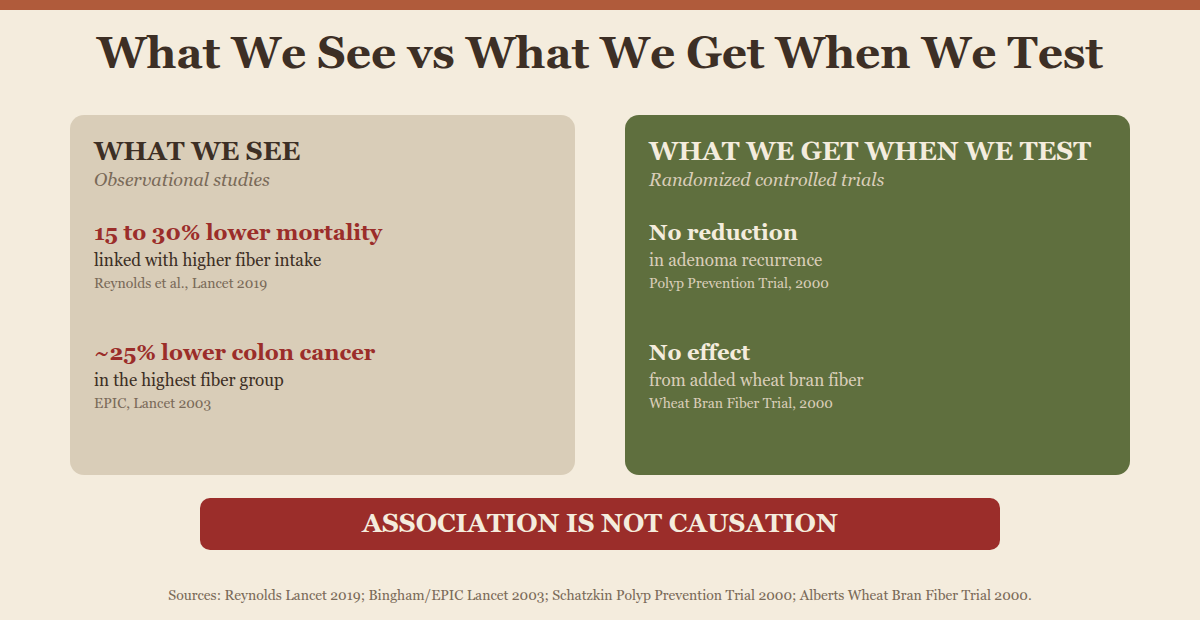
So the honest state of the colon-cancer evidence is this. When you watch what people happen to eat, fiber looks protective. When you actually assign it, the protection vanishes. One standard for everyone means I have to tell you that the stronger study design, the one that can actually separate cause from company, did not find the benefit. That does not prove fiber does nothing. It proves the confident claim that fiber prevents colon cancer is standing on much softer ground than you were told.
The regularity surprise
Now the one everybody is sure about. "You need fiber or you will get constipated." It is the most repeated benefit of all, and for a lot of people, adding fiber and water does help. I am not disputing that it works for some.
But it is not the universal law it is sold as. A 2012 study took 63 people with stubborn idiopathic constipation and did something almost nobody thinks to try: it reduced their fiber, in some cases to zero, and watched. The people who cut fiber out entirely went from one bowel movement every 3.75 days to one a day. Their bloating and straining eased too. Meanwhile the group that stayed on high fiber kept sitting at roughly one movement every 6 to 7 days.
I want to be careful and hold this study to the same bar I held the others. It was small, and it was not randomized: the patients were following advice and self-selecting into groups, which is a weaker design than the colon-cancer trials above. So I am not going to tell you fiber causes constipation as some iron rule. What this study honestly shows is narrower and still important: for some people, more fiber is making the exact problem worse that they were told it would fix. Regularity turns out to be individual, not a simple "more fiber, more movement" dial.
The disease fiber was supposed to prevent
Here is the beat that genuinely surprised me. Diverticulosis, those little pouches in the colon wall, was Burkitt's flagship example. Low fiber, went the story, means hard stools, means straining, means pouches. Eat your fiber and you will not get them.
Then someone measured it properly. A 2012 study in Gastroenterology looked at over 2,000 people who had colonoscopies and compared their actual fiber intake against what was found. The result ran backward. The people eating the most fiber had more diverticulosis, not less, with about a 30 percent higher prevalence in the high-fiber group. The exact disease fiber was supposed to prevent was more common in the people eating the most of it.
One study does not overturn a field, and I will not pretend it does. But it lands squarely on Burkitt's most famous claim, and it is a clean example of what happens when a comfortable hypothesis finally meets a measurement: sometimes the arrow points the opposite way.
My own experiment
I will not hide behind the studies, because I also tested this on the only subject I fully control: myself. Take this for exactly what it is, one person's experience, not proof and not a prescription for you. But it is honest, and it is why I went and read all of the above in the first place.
At the time of writing I have eaten a carnivore diet for seven months. Meat, eggs, animal fat, almost nothing that grows. On paper, according to everything I was ever taught, this should have been a disaster. Near zero fiber. No plants. No "complex carbs for energy." I should be constipated, scurvy-ridden, and dragging myself through the afternoon.
Here is what actually happened. I lost about 30 pounds (about 14 kg). I have had no constipation and no intestinal upset, in fact the opposite: I have a bowel movement at least once a day, on zero fiber, more reliably than I did before. No scurvy, despite the warnings, and it is worth knowing that fresh meat does contain some vitamin C and that a low-carbohydrate diet lowers how much vitamin C the body burns through in the first place, so the plates-or-scurvy choice was never as stark as it sounds. And my energy, which used to crater every afternoon when I ate the "balanced" way, is steady from morning to night without a single carb to prop it up.
That is an anecdote. I know the difference between my own story and a controlled trial, and I am labeling it clearly as the former. But it is a data point that the standard advice said was impossible, and there are a great many people now living the same one.
Not all fiber is the same thing anyway
One more distinction, because the word "fiber" hides a sleight of hand. The fiber in a bowl of berries or a cooked potato is not the same experience as the "added fiber" stirred into a protein bar, or the isolated inulin and chicory root now sprayed onto processed food so the box can claim a health halo. When you eat whole foods that happen to contain fiber, you get the whole package. When you buy fiber that has been extracted and added back, you are often just eating a processed product with a marketing claim. So even the useful version of "eat your fiber" was really "eat whole, real food," which is advice I agree with completely and which has nothing to do with dumping bran into everything.
So, do you need it?
Here is where the evidence actually leaves us, stated as plainly as I can.
Fiber is not an essential nutrient. There is no fiber-deficiency disease. The official guidelines themselves quietly admit this: fiber does not have a Recommended Dietary Allowance, the number set for things you truly must consume, but only an Adequate Intake, a softer target. Whole human cultures have lived long, robust lives on almost none of it, and others on mountains of it. It is not a vitamin. It is not a requirement.
That does not make it poison. If you eat real, whole plant foods and they suit you, you will get fiber and you will very likely do fine, and nothing here is a reason to fear an apple. What the evidence does not support is the commandment: the idea that everyone, always, needs to chase a fiber number, that more is automatically better, and that you are harming yourself without it. When it was actually put to the test, the strongest protective claims either failed to replicate or ran backward, and some people are visibly healthier with far less of it.
So the real answer to "do you need fiber" is the same unsatisfying, honest answer that keeps showing up on this site once you stop trusting the slogans. It depends on you. Some people run better with a lot of plant matter. Some, and I am one of them, run better with almost none. The one thing that is not true is the thing we were all told without question: that it is essential, and that the number on the box is a law you break at your peril.
Your great-grandparents did not count fiber grams. Some ate a great deal of it and some ate almost none, depending on where and how they lived, and the human body handled both. That flexibility is not a bug to be corrected with a supplement. It may be the most ancestral thing about us.
This is one person's reading of the evidence and one person's experience, not medical advice. If you have a diagnosed gut condition, work it through with a clinician who will look at you specifically, which is the whole point.
Sources
- Reynolds A, Mann J, Cummings J, et al. "Carbohydrate quality and human health: a series of systematic reviews and meta-analyses." Lancet 2019;393(10170):434-445. PMID 30638909
- Bingham SA, Day NE, Luben R, et al. (EPIC). "Dietary fibre in food and protection against colorectal cancer in the European Prospective Investigation into Cancer and Nutrition." Lancet 2003;361(9368):1496-1501. PMID 12737858
- Schatzkin A, Lanza E, Corle D, et al. "Lack of effect of a low-fat, high-fiber diet on the recurrence of colorectal adenomas" (Polyp Prevention Trial). N Engl J Med 2000;342(16):1149-1155. PMID 10770979
- Alberts DS, Martinez ME, Roe DJ, et al. "Lack of effect of a high-fiber cereal supplement on the recurrence of colorectal adenomas" (Wheat Bran Fiber Trial). N Engl J Med 2000;342(16):1156-1162. PMID 10770980
- Ho KS, Tan CYM, Mohd Daud MA, Seow-Choen F. "Stopping or reducing dietary fiber intake reduces constipation and its associated symptoms." World J Gastroenterol 2012;18(33):4593-4596. PMC3435786
- Peery AF, Barrett PR, Park D, et al. "A high-fiber diet does not protect against asymptomatic diverticulosis." Gastroenterology 2012;142(2):266-272. PMID 22062360
- Smits SA, Leach J, Sonnenburg ED, et al. "Seasonal cycling in the gut microbiome of the Hadza hunter-gatherers of Tanzania." Science 2017;357(6353):802-806. PMID 28839072
- Quagliani D, Felt-Gunderson P. "Closing America's Fiber Intake Gap." Am J Lifestyle Med 2017;11(1):80-85. PMC6124841