The Cholesterol Myth: How We Were Taught to Fear Our Own Food

Short answer: For most people, eating cholesterol-rich real foods like eggs and red meat does not cause heart disease. That fear grew out of a shaky 1950s theory that was never firmly proven. Below, I trace where it came from and what our ancestors ate instead.
For more than half a century, Americans have been afraid of an egg yolk. We were told that the cholesterol in our food clogged our arteries, that the saturated fat in butter and beef was slowly killing us, and that the responsible thing to do was to trade the foods our great-grandparents thrived on for margarine, egg whites, and breakfast cereal.
It was one of the most successful public health campaigns in history. It was also wrong.
This is the story of how a single hypothesis, propped up by selected data and quietly funded by the sugar industry, became a national commandment. It is also the story of what happened every time someone actually put that commandment to the test, and why the people who kept eating real food were never the ones who needed to worry.
How a hypothesis became a commandment
In the 1950s, heart disease was rising and frightening, and the country wanted an answer. A researcher named Ancel Keys offered one that was simple enough to fit on a poster: the fat you eat raises the cholesterol in your blood, and that cholesterol clogs your arteries. He called it the diet-heart hypothesis.
It was a tidy idea, and tidy ideas spread fast. Within two decades it had captured the American Heart Association, the federal government, and eventually the breakfast table. The trouble is that a hypothesis is not a fact. It is a claim waiting to be tested. And the way this one was sold to the public skipped that step almost entirely.
The chart that left out the inconvenient countries
The picture that made Keys famous came early, in a 1953 paper, and it was a graph comparing national fat consumption to heart disease deaths across six countries. The dots lined up beautifully. More fat, more death. The case looked closed. (This is not the same as his later Seven Countries Study, a far larger project he launched in 1958 that followed thousands of individual men. The two are constantly confused, but it was this earlier six-country graph that did the persuading.)
But the data existed for far more than six countries. In 1957, two researchers named Jacob Yerushalmy and Herman Hilleboe pointed out the obvious problem. When you plotted all twenty-two countries for which numbers were available, Keys's dramatic, almost perfect line shrank into a loose and modest scatter. The association did not vanish, and honesty demands saying so. But it went from looking like an iron law of nature to looking like what it actually was: a weak correlation across whole countries, the kind that proves very little on its own. Keys had simply shown the handful of nations that fit the story most cleanly and left the messier rest off the page.
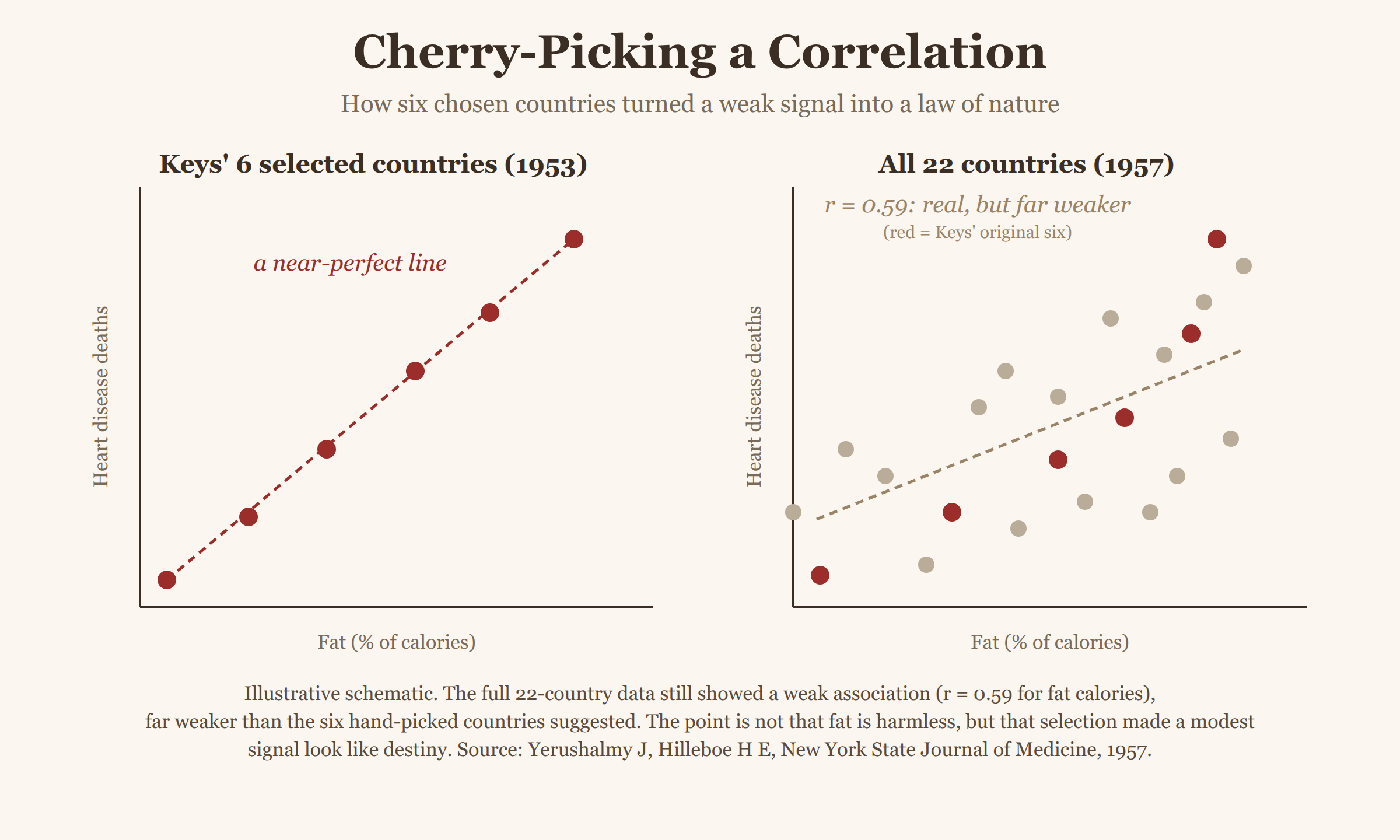
Their warning is worth quoting, because it is the whole game in a single sentence. "The method of selecting data," they wrote, "largely determines whether the results can safely be generalized." Show the right six dots and you can make a modest signal look like destiny. And there is a deeper trap underneath: a correlation drawn across entire countries cannot tell saturated fat apart from everything else that travels with it, the sugar, the wealth, the cigarettes, the sheer amount of processed food. Keys had not proven that fat causes heart disease. He had drawn a suggestive picture and let the world treat it as a verdict.
Follow the money
There was another thumb on the scale, and it took nearly fifty years to come to light. In 2016, researchers at the University of California published an investigation in JAMA Internal Medicine into the internal documents of the sugar industry. What they found should be taught in every nutrition class.
In the 1960s, the sugar trade quietly paid Harvard scientists to write a major review of heart disease and diet. That review, published in the New England Journal of Medicine in 1967, waved away the growing evidence against sugar and pointed the finger squarely at fat and cholesterol instead. The funding was never disclosed, because in those days the journal did not require it.
The investigators were careful, and so will I be: there is no proof that the sugar industry dictated a single sentence of that review. What the documents show is that the men who shaped a generation of dietary advice were on the payroll of an industry with everything to gain from blaming fat. At the very moment the case against fat was hardening into law, the case against sugar was being softened by the people who sold it.
What happens when you actually test it
A correlation drawn across countries is a place to start asking questions, not a place to stop. The real test of the diet-heart hypothesis was always the controlled trial: take people, lower their saturated fat, replace it with vegetable oil, and see if fewer of them die. Those trials were done. The results were not what you were told.
The most damning was the Minnesota Coronary Experiment, which fed more than nine thousand people either their usual diet or one in which saturated fat was swapped for corn oil. The corn oil worked exactly as predicted on paper. Cholesterol dropped, and dropped hard. But the people whose cholesterol fell did not live longer. If anything, the older ones died sooner. Then the most telling detail of all: the full results sat unpublished for roughly forty years, recovered only in 2016 by a researcher digging through old magnetic tapes. The experiment that should have crowned the hypothesis had quietly buried it instead.
It was not an isolated fluke. When researchers pooled the long-term observational studies, the supposed link kept thinning out. A 2010 analysis followed nearly 350,000 people and found no significant association between saturated fat and heart disease. A 2014 review covering more than 600,000 people reached the same conclusion. A massive 2017 study across eighteen countries found that the people eating more saturated fat were not dying more, while the people eating the most carbohydrate were. The fat we were taught to fear kept failing to show up at the scene of the crime.
I will be honest about the one finding the other side leans on, because honesty is the entire point of this post. A 2020 Cochrane review concluded that cutting saturated fat does not lower the risk of dying, from heart disease or anything else. It did find a modest reduction in non-fatal heart events. That is the real picture: not a clean victory for either camp, but nothing remotely like the deadly poison we were promised. You do not rebuild the American diet around a maybe.
The cap they quietly removed
Here is the part that should make you angry, or at least set you free. The official guardians of the rules have already surrendered, and almost nobody noticed.
For decades the Dietary Guidelines for Americans capped cholesterol at 300 milligrams a day, the number that made eggs a moral hazard. In the 2015 to 2020 edition, that cap vanished. The committee stated plainly that cholesterol is "not a nutrient of concern for overconsumption." The reason is simple and was known for years: your liver makes most of the cholesterol in your body, and when you eat more, it makes less. For most people the cholesterol on the plate barely moves the cholesterol in the blood.
Even Harvard, no friend of butter, now puts it flatly. As one of its medical editors wrote in 2024, "for most people, an egg a day does not increase your risk of a heart attack, a stroke, or any other type of cardiovascular disease." The advice that emptied your grandmother's refrigerator of eggs has been retracted in everything but the apology.
The heart attack that nobody had seen before
Here is a piece of history that should stop you cold. In June of 1911, Procter and Gamble put a brand new kind of fat on American shelves. They called it Crisco, and it was something the human body had never encountered: cottonseed oil, an industrial leftover, forced solid through a chemical process called hydrogenation. The company gave away cookbooks in which every recipe called for it, and taught a generation to stop asking what was in their food and simply trust the brand.
One year later, in 1912, a Chicago physician named James Herrick stood before his colleagues and laid out the clinical picture of a heart attack, a coronary artery suddenly blocked, in what became the landmark paper on the subject. The striking part is what happened next. Nothing. In Herrick's own words his presentation "fell like a dud," and drew no real response for six years. The doctors in that room were not unmoved because they were slow. They were unmoved because the thing he described was, to them, a rarity most of them had never seen. Within a few decades it would be the leading cause of death in the country.
I want to be careful here, because careful is the entire point of this series. A strange new fat arriving the year before the heart attack got its first great description does not prove the fat caused the disease. A great deal changed in the twentieth century. But it is a timeline worth sitting with, and it is the thread I will pull all the way in a coming post on the vegetable oil fraud: how an industrial seed oil that began as raw material for soap ended up in nearly everything we eat, and what showed up alongside it.
So what was actually making us sick?
If it was not the steak and eggs our great-grandparents ate without fear, then what changed? Look at what replaced them. As the fat came off the plate, sugar and refined grain and industrial seed oil came on. We did not return to an older, simpler way of eating. We invented an entirely new one out of boxes and bottles, and our health collapsed on schedule.
The more honest researchers have moved on from blaming single nutrients toward the things that actually track with modern disease: insulin resistance, the metabolic wreckage of constant sugar, chronic inflammation. This is the deeper logic behind the foundations of health. Whole food, eaten in a form your body recognizes, does not need a warning label. The bottle of seed oil and the bowl of sweetened grain are the genuine newcomers here, and they arrived exactly when the trouble did.
A word of honesty
This is not a license to pretend nothing matters. Saturated fat does raise LDL cholesterol in the blood, and that is real, even if the link from there to an early grave turned out to be far weaker than we were told. A small share of people are genuine hyper-responders whose cholesterol climbs sharply on a rich diet, and people with familial hypercholesterolemia or established heart disease have every reason to work closely with a doctor who knows their body. This is not medical advice, and one blog post does not override your own physician.
What I am asking you to give up is not caution. It is fear, the inherited, manufactured fear of an egg yolk and a pat of butter. You are allowed to look at the actual evidence, see how thin the case always was, and decide for yourself.
And if you suspect the fear you were sold was never really about cholesterol but about meat itself, you are right to look closer, because the same pattern repeats: a weak, confounded signal inflated into a death sentence. I take that question apart in does red meat really shorten your life?.
This post is the companion to the all-American breakfast they taught us to fear, which lays out just how much nourishment is waiting on that plate once the fear is gone.
Follow the wisdom of the ancients
Our great-grandparents ate the yolk, cooked in the fat, and built a country. They were not reckless. They simply had not yet been taught to be afraid of their own food. We were taught, and we got sicker for it, and now the very authorities who taught us are walking it back one quiet revision at a time.
You do not have to wait for them to finish apologizing. The eggs are still in the store, the butter is still real, and the truth was never as complicated as they made it sound. Crack the eggs. Keep the yolk. Follow the wisdom of the ancients.
Sources
- Yerushalmy J., Hilleboe H.E. Fat in the diet and mortality from heart disease: a methodologic note. New York State Journal of Medicine, 1957. The twenty-two-country reanalysis showing Keys' six-country selection greatly exaggerated the fat and heart disease association.
- Kearns C.E., Schmidt L.A., Glantz S.A. Sugar Industry and Coronary Heart Disease Research: A Historical Analysis of Internal Industry Documents. JAMA Internal Medicine, 2016; 176(11):1680 to 1685. The sugar industry funded a 1967 review while concealing its role; the authors note there is no direct evidence the industry altered the manuscript text.
- McGandy R.B., Hegsted D.M., Stare F.J. Dietary fats, carbohydrates and atherosclerotic vascular disease. New England Journal of Medicine, 1967. The industry-funded review that shifted blame from sugar to fat and cholesterol.
- U.S. Senate Select Committee on Nutrition and Human Needs. Dietary Goals for the United States, 1977. First federal targets: about 30 percent of calories from fat, 10 percent from saturated fat, and under 300 mg of cholesterol per day.
- Ramsden C.E., et al. Re-evaluation of the traditional diet-heart hypothesis: analysis of recovered data from the Minnesota Coronary Experiment (1968 to 1973). BMJ, 2016; 353:i1246. Replacing saturated fat with linoleic-acid vegetable oil lowered cholesterol but did not lower mortality, and may have raised it in older adults; full data went unpublished for roughly forty years.
- Siri-Tarino P.W., Sun Q., Hu F.B., Krauss R.M. Meta-analysis of prospective cohort studies evaluating the association of saturated fat with cardiovascular disease. American Journal of Clinical Nutrition, 2010; 91(3):535 to 546. No significant association between saturated fat and coronary heart disease, stroke, or cardiovascular disease across 347,747 subjects.
- Chowdhury R., et al. Association of dietary, circulating, and supplement fatty acids with coronary risk: a systematic review and meta-analysis. Annals of Internal Medicine, 2014; 160(6):398 to 406. Relative risk for coronary disease of 1.03 for saturated fat, not statistically significant, across studies covering more than 600,000 people.
- Dehghan M., et al. Associations of fats and carbohydrate intake with cardiovascular disease and mortality in 18 countries from five continents (PURE): a prospective cohort study. Lancet, 2017; 390(10107):2050 to 2062. Saturated fat was not associated with higher mortality and was inversely associated with stroke; high carbohydrate intake was associated with higher total mortality. An observational study, and a contested one.
- Hooper L., et al. Reduction in saturated fat intake for cardiovascular disease. Cochrane Database of Systematic Reviews, 2020; CD011737. Cutting saturated fat showed little or no effect on all-cause or cardiovascular mortality, with a modest reduction in combined cardiovascular events.
- U.S. Department of Agriculture and U.S. Department of Health and Human Services. Dietary Guidelines for Americans, 2015 to 2020. The 300 mg per day dietary cholesterol cap was removed; cholesterol was described as "not a nutrient of concern for overconsumption."
- LeWine H.E. Are eggs risky for heart health? Harvard Health Publishing, April 2024. "For most people, an egg a day does not increase your risk of a heart attack, a stroke, or any other type of cardiovascular disease."
- Herrick J.B. Clinical features of sudden obstruction of the coronary arteries. JAMA, 1912. The landmark clinical description of myocardial infarction; Herrick recalled that the presentation "fell like a dud" and drew little response for about six years.
- Procter and Gamble. Crisco, introduced June 1911 as the first shortening made entirely of vegetable oil, produced by hydrogenating cottonseed oil. Marketed with free cookbooks in which every recipe called for Crisco.