The Sun Did Not Change. We Did.

Short answer: The sun has not become more dangerous. What changed is us, mainly modern diets heavy in seed oils and processed food, which alters how our skin handles sunlight. Sensible sun exposure is a basic human need, not something to fear. Here is what actually shifted.
Have we been lied to about the sun?
Every summer the warning gets louder. Cover up. Reapply. Stay inside between 10 and 4. Skin cancer rates keep climbing, and the sun gets blamed like it just arrived on the scene. But the sun has been doing the same thing for a few billion years. What changed is us: what we eat, how we live, and the pattern in which we meet the light. We did not change the sun. We changed the human, and then blamed the sun.
Meet your ancestor
Picture your great-great-grandparent in 1850. Outdoor labor from sunup to sundown, most of the year, most of their life. No sunscreen (it did not exist). No wide-brim marketing campaign telling them to fear the sky. They ate what the land gave them: butter, lard, tallow, organ meats, raw milk, fermented vegetables. No Crisco (that arrives in 1911). No bottle of seed oil. No aisle of ultra-processed food.
Ask the honest question: where was the melanoma epidemic? Where was the wave of deadly skin cancer cutting down farmhands and field workers, the people who spent their whole lives under the open sky? We find no sign of one, and it is worth asking why before you accept that the sun itself became the villain of the story.
It was never sun versus no sun
Here is the reframe. The choice was never "get sun" or "avoid sun." It was matched versus mismatched. Human skin and human latitude co-evolved together over tens of thousands of years: darker skin near the equator, paler skin farther from it. Melanoma spikes where that pairing breaks down, fair skin baking under tropical sun, or dark skin boxed indoors under artificial light and then thrown into the sun for two vacation weeks a year. What was ancestral was never the absence of sun. It was the match between your skin and your dose.
The dose pattern itself flipped. Your ancestor got continuous, moderate, adaptive sun: a gradual tan built over months, instinctive midday shade, rarely a burn. The modern pattern is close to zero sun for fifty weeks, then a blistering burn on a beach vacation. That intermittent, burning pattern is what tracks with melanoma. Chronic, steady, outdoor exposure does not.
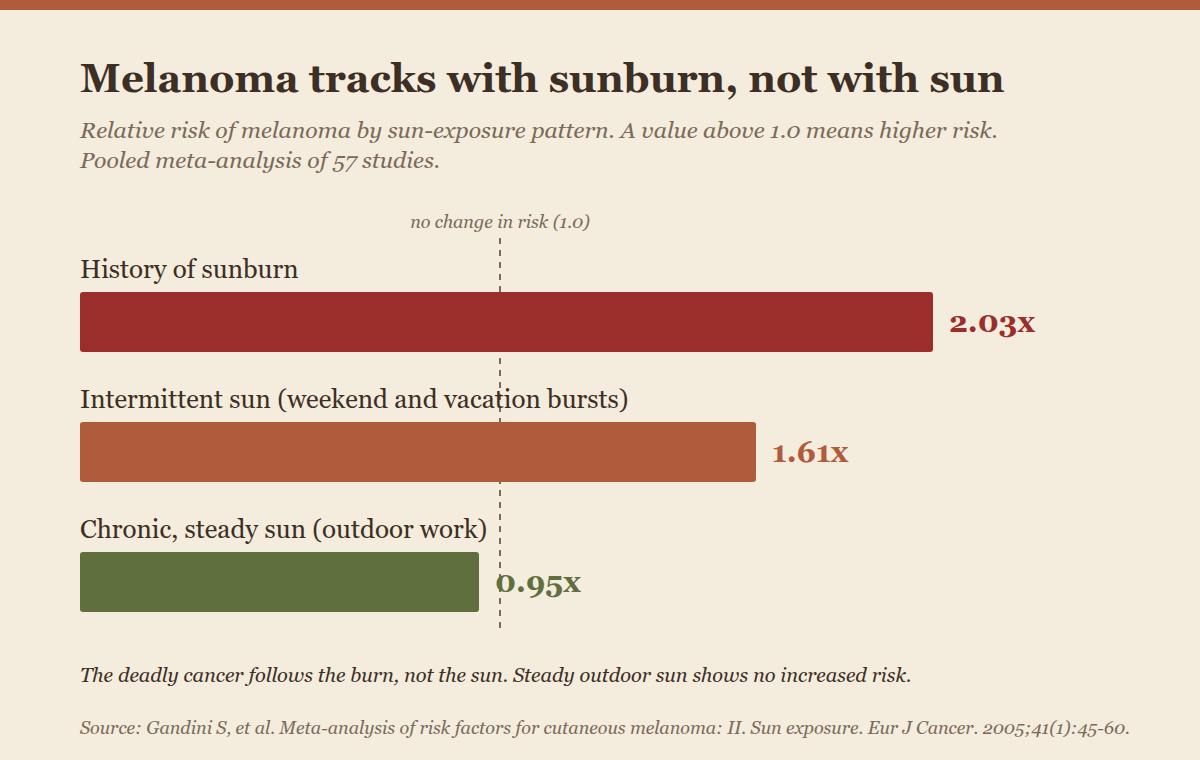
This is not a hunch. The largest pooled analysis of the sun-exposure literature, Gandini and colleagues in the European Journal of Cancer (2005, 57 studies combined), found a history of sunburns raised melanoma risk about 2 times. Intermittent sun exposure raised it about 1.6 times. Chronic, continuous exposure, the kind outdoor workers get, showed no increased risk at all (relative risk 0.95, essentially neutral to slightly protective). A separate analysis by Elwood and Jopson in the International Journal of Cancer (1997) found the same pattern: heavy occupational sun exposure was associated with lower melanoma risk than the lighter, intermittent kind. The people who spent their whole lives in the sun were not the ones getting melanoma. The people who spent their lives avoiding it, then burning on the rare occasion they got it, were.
That is not a footnote. That is the whole story hiding inside the data the establishment already accepts.
The occupational data above is modern: outdoor workers alive today, tracked by real epidemiologists, and they still show lower melanoma risk on heavy chronic sun exposure than people with light, intermittent exposure (Elwood and Jopson, OR 0.86 for heavy occupational exposure). If sun exposure itself were the simple driver, the lifelong outdoor workers should have the worst melanoma numbers. They have some of the best. Be clear about what this does and does not say: chronic sun does raise the common, rarely fatal skin cancers, the basal and squamous cell type a dermatologist freezes off and you carry on with. What it does not do is drive the deadly one. Melanoma tracks the burn, not the years outdoors.
We already saw who actually gets melanoma, and it is not the lifelong outdoor workers (the occupational data is modern and solid). Add the map to it. The highest melanoma rates on earth are in Australia and New Zealand, where fair, northern-European skin sits under a subtropical sun it never evolved for; the same skin in Ireland sees far less. It is the mismatch between skin and sun, not the sun alone.
One honest caveat, because we hold everyone to the same standard, ourselves included. Part of the modern "epidemic" is simply better looking. Melanoma diagnoses have risen roughly sixfold in fifty years while deaths have barely moved, the classic fingerprint of catching more small, harmless lesions rather than a true surge. So we will not oversell the size of the rise. And we will not pin it on a single cause: the diet changed, so did indoor work, migration to sunnier latitudes than our skin evolved for, and tanning beds. The honest position is not "the sun did it" or "the seed oil did it." It is that the sun did not change, the terrain it lands on did, and more than one thing moved at once. The point was never the raw count. It is the pattern: intermittent burning, on skin under the wrong sun, on top of a changed diet.
What changed the terrain
If the sun did not change, something else did: Here is a hypothesis, and it should be labeled exactly that, a hypothesis, not a settled fact: dietary seed oils are structurally fragile fats that accumulate in the skin and oxidize readily under UV light, making skin more prone to burning and inflammation. Ancestral animal fats, saturated and more UV-stable, may build more sun-resistant skin. If even partly true, the sun did not turn dangerous on its own. It turned dangerous downstream of the seed-oil diet, the same villain behind the cholesterol and vegetable-oil story, showing up in a different organ.
We are not the first to make this mistake. Read the cholesterol myth and you will find the exact same pattern: a food swapped out (animal fat), a food swapped in (refined seed oil and sugar), and the wrong ingredient blamed for the resulting damage. If you have not made the connection between what disappeared from the American plate and what showed up instead, steak and eggs lays out what your great-grandparents were actually eating, and why it built resilience rather than disease.
The sunscreen turn, handled carefully
None of this means throw away your sunscreen just yet. Read below first.
There are real, sourced concerns worth knowing. A randomized clinical trial by Matta and colleagues, published in JAMA in 2019 and repeated in 2020, found that common chemical UV filters (oxybenzone, avobenzone, octocrylene, and ecamsule) are absorbed into the bloodstream at levels exceeding the FDA's own safety testing threshold after just one day of labeled use, oxybenzone climbing especially high. That finding does not prove harm. It proves the FDA's own threshold for requiring a full safety review was crossed, which is why the agency asked for more data in the first place.
Separately, the pharmacy Valisure filed a citizen petition with the FDA in 2021 after testing 294 batches of sunscreen and after-sun products from 69 brands. About 27% of those batches contained benzene, a known carcinogen, some above the FDA's own restricted limit. That petition led to real recalls, including Johnson & Johnson pulling several Neutrogena and Aveeno aerosol sunscreens and Coppertone recalling specific aerosol lots later that year.
There is one more piece, and it points at the mineral sunscreens too, not just the chemical ones. Most mineral sunscreens now grind their zinc oxide or titanium dioxide down into nanoparticles, particles small enough that the long-term science on them is simply not settled. Here is the honest state of it, held to the same standard as everything else in this piece. Regulators agree these particles sit on the surface of healthy, intact skin and do not soak into living tissue, so this is not a claim that nano mineral sunscreen is poisoning you through your skin. I personally avoid these types of sunscreen anyway but you decide your level of risk. The open questions are different ones. Titanium dioxide is classed by the World Health Organization's cancer agency as possibly carcinogenic when its powder is inhaled, which is exactly why spray and loose-powder sunscreens are the real concern, not creams. And Europe's own safety committee has declined to certify some nano forms as safe for every route of exposure, citing gaps in the data rather than a clean bill of health.
My stance on that is simple, and it is the ancestral one: a new, barely-tested material does not earn the benefit of the doubt just because no one has proven it dangerous yet. The burden of proof belongs on the product, not on your body. Titanium dioxide was treated as harmless for decades, right up until 2021, when European regulators reversed themselves and pulled it out of the food supply entirely because they could no longer rule out damage to DNA. That is the whole point: "no evidence of harm" and "proven safe" are not the same sentence, and a corporation's word that something is fine is not the same as evidence that it is. Until nano is proven safe rather than merely unproven dangerous, the cautious move is to skip it.
So what do you actually do? Start where your great-great-grandparents started, with what you do, not what you buy. The best sun protection ever invented is free. Seek shade in the middle of the day, when the sun is at its hardest (roughly 10 in the morning to 4 in the afternoon). Wear a wide-brim hat and light clothing that covers your skin; fabric rated UPF 50 blocks about 98 percent of UV, and unlike any lotion it never wears off or washes away. Build your exposure up slowly across the season instead of frying yourself in a single afternoon. The World Health Organization and the CDC both recommend exactly this, and it is exactly what a field worker in 1850 did by instinct.
When you do need sunscreen on skin you cannot cover, keep it simple. Choose a non-nano zinc oxide cream (yes, "non-nano" is a real label you can look for). Avoid the sprays and powders you can breathe in. Skip the oxybenzone-heavy chemical formulas, the same ones the FDA found absorbed into the bloodstream above its own testing threshold, and the same ones Hawaii and Key West banned for bleaching their coral reefs. If you want a shortcut for reading labels, the Environmental Working Group publishes a free annual sunscreen guide at ewg.org/sunscreen that lets you filter for exactly these things; treat it as a shopping tool, not gospel. And above all, do not burn. Absorption above a threshold is not the same as proven harm, and a contaminant in some batches is not an ingredient in every bottle, but you do not need certainty about the risks to make the simple, ancestral choice: cover up, seek shade, and save the bottle for when you truly need it.
A fair objection: "you're just anti-sunscreen, and sunscreen is proven." Two honest answers, and we will dodge neither.
First, sunscreen is on our side, if you must use it. When researchers in Australia ran the rare randomized trial, the daily-sunscreen group had less melanoma years later (11 new melanomas versus 22). If burning is the problem, anything that stops you burning is a tool worth having. So when you cannot cover up and the sun is hard, reach for a simple non-nano zinc cream like Badger Balm: it sits on top of the skin and blocks the burn without the fragrance and additive load of the aerosol versions.
Second, when we do raise concerns about the chemical filters, we hold them to the strict bar too, and here the objection has the evidence backward. The strongest sunscreen-chemistry finding above, Matta in JAMA, is a randomized clinical trial, which sits higher on the evidence ladder than the sun-pattern data, which is observational epidemiology. So if we are ranking by study design, the sunscreen-absorption evidence is the better-built of the two, and we still only call it suggestive, not proof of harm. That is us holding our own side to the strict bar.
And the deeper point is not the bottle at all. The same UVB rays that burn you are the ones your skin uses to make vitamin D, whose low levels track with worse health across a large body of research. Block the sun completely and you lose the burn and the benefit together. So the ancestral move is tactical, not total: take your short, regular, non-burning dose of sun, then save the sunscreen for the hours you know would burn you. You are not choosing between sun and sunscreen. You are using the sun for what it gives you, and the sunscreen for the moments it would take too much.
Apply that same single standard to the sun itself, and be careful what it actually proves. One ruler for every claim: is the effect large, dose-responsive, mechanistically plausible, and does it repeat across independent studies? By that ruler, two things pass, and we will say both out loud. Ultraviolet light causes melanoma. That is mainstream, heavily replicated, and we are not disputing it. And intermittent, burning exposure carries more melanoma risk than steady, lifelong exposure. That is the Gandini and Elwood pattern, and it clears the bar too. What does not clear the bar is the bigger, cozier claim that the sun is simply harmless. We are not making that claim. The narrow, well-supported one is enough: it is the burn, and the mismatch between your skin and your dose, that carries the risk, not the time spent outdoors.
Your best sunscreen is on your plate
Here is the part the sunscreen aisle will never tell you: the strongest sun protection your great-great-grandparents had was not something they smeared on their skin. It was what they ate, and how they met the light.
Start with the food, because this is where the real evidence sits. Eat a diet rich in colorful plants and whole animal foods, and your skin literally becomes harder to burn. In human trials, dietary carotenoids, the pigments in carrots, tomatoes, and leafy greens, raised the skin's own sunburn threshold after about ten weeks of steady eating (Kopcke and Krutmann's meta-analysis, and a separate tomato and lycopene trial). The omega-3 fats in fatty fish and pastured animals raised that threshold too (Pilkington and colleagues). This is not a cream you apply in the morning. It is a terrain you build over months, which is exactly how your ancestors ate their way into sun-resilient skin without ever thinking about it. It is also the same fork in the road as the rest of this story: the animal-fat, real-food plate builds resilience, and the seed-oil plate, at least in the animal studies so far, appears to do the opposite.
Be clear about what does not work, so nobody gets burned trying it. Rubbing cooking oil on your skin is not sun protection. Coconut, olive, and almond oil measure only a low single-digit SPF in a laboratory dish, give no protection against UVA at all, and rub off in minutes (Kaur and Saraf). There is no real measurement showing tallow or any animal fat blocks the sun. Oils moisturize. They do not shield. Do not use them as sunscreen.
Then there is the oldest skill of all, the one modern life stole from us: meeting the sun in stages. The lighter your skin, the more gently you start. A few minutes of soft morning or late-afternoon sun, then a little more the next day, and a little more the day after, so your skin adapts instead of getting ambushed. Over weeks the outer layer thickens and your threshold to burn slowly rises. Be honest about the size of this, because one standard applies here too: the protection is modest, closer to a low SPF than a high one, and the dermatologists are right that a deep tan is itself a sign of damage, not a badge of health. So the goal was never the tan. The goal is to never, ever burn. The burn is the one thing the data actually ties to melanoma. Gradual adaptation is simply how a body meets the sun the way it did for a few hundred thousand years: a little at a time, building tolerance, never in a single blistering afternoon.
And keep a bottle of 100 percent aloe vera on the shelf, just in case. If you misjudge it and go pink, pure aloe is the sensible ancestral first aid: the evidence shows it modestly speeds the healing of minor burns (though not that it kills the pain, and certainly not that it undoes real damage). It is not a license to burn. It is just a simple, soothing thing to have on hand for the rare mistake.
None of this is exotic. It is what people did before the aisle of bottles existed: eat real food, cover up and seek shade when the sun is hard, meet the light a little at a time, and keep something soothing for the occasional slip.
"People back then did not live long" is a statistical illusion
One more objection tends to end these conversations before they start: people in 1850 did not live long enough for any of this to matter. It is one of the most repeated, least examined claims in the entire wellness conversation, and it rests on a basic statistical mistake.
Real demographic data (Haines, Historical Methods, 1998, and the Historical Statistics of the United States, 2006) puts US life expectancy at birth in 1850 at around 39 to 40 years. That number is real. What it hides is why it is so low: brutal infant and child mortality, not adults dropping dead in their prime. Roughly 1 in 5 infants died in their first year alone. A statistic like "life expectancy 40" describes an average dragged down hard by a death toll concentrated almost entirely in early childhood, not a ceiling on how long a healthy adult could expect to live.
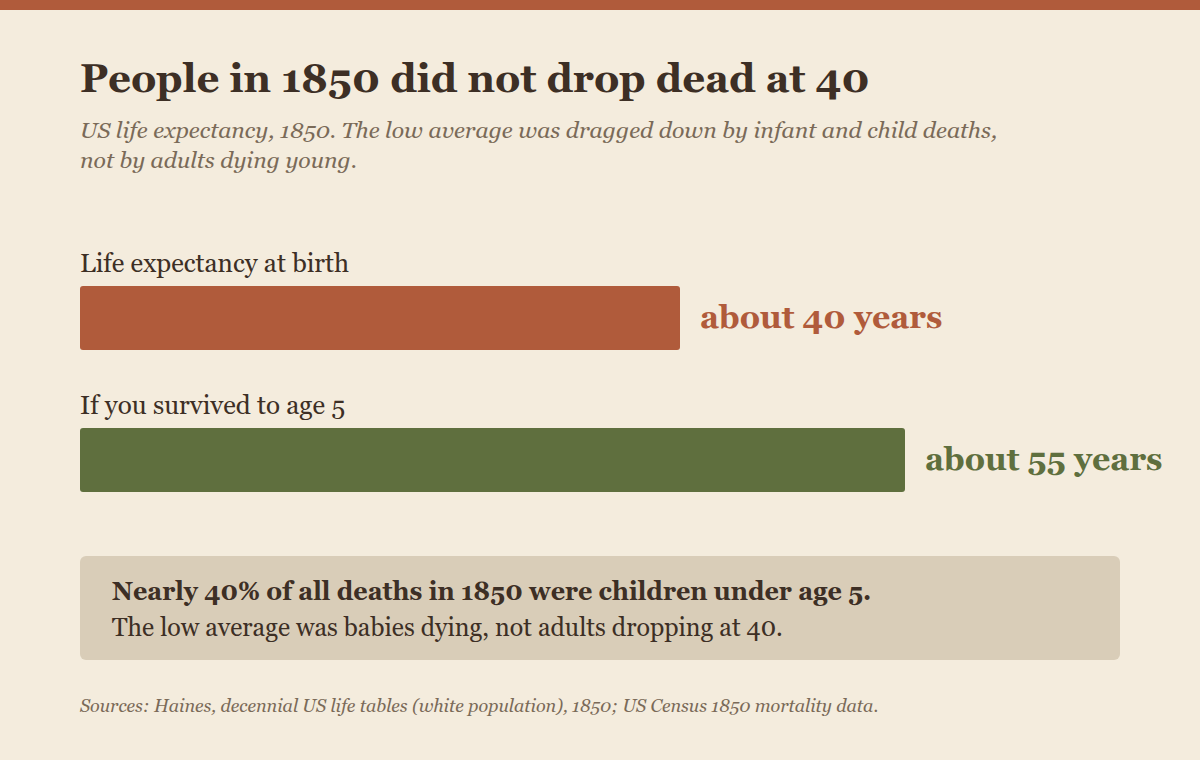
Once someone survived infancy and childhood, the numbers change completely. Adults who reached maturity in that era commonly lived into their 60s and beyond. And we do not need statistics alone to make the point: Benjamin Franklin lived to 84. Thomas Jefferson to 83. John Adams to 90. These are anecdotes, not proof, and we say that plainly rather than overclaiming, but they illustrate something the "people did not live long" line conveniently erases: the ceiling on a human life was never low. The floor, childhood mortality from infection and injury we can now treat, was what was deadly. And the adults who reached old age did it while living outdoors, unprotected from the sun, eating whole animal foods. That is the exact population the "the sun is what's making us sick" story cannot explain.
What your great-great-grandparents already knew
You do not need a peer-reviewed study to reclaim what your ancestors did by default. Get sensible daily sun, and do not let it turn into a burn. Eat like your skin, your hormones, and your metabolism are all built from the same fats you put on your plate; does red meat really shorten your life walks through why the animal-fat side of that plate was never the enemy epidemiology made it out to be. Choose non-nano zinc oxide when you actually need coverage, skip the chemical formulas and the breathable sprays, and reach for shade, a hat, and covered skin first. Question who profits when the answer to "go outside and eat real food" gets replaced with a bottle and a warning label. Read the foundations of health for the fuller picture of how sunlight, food, sleep, and movement work together as one system, not four separate problems.
The sun was there in 1850. Waiting a hundred years for the diet and the daily pattern to change enough to let it in. What did your great-great-grandparents know about the sun that we forgot? Mostly this: it was never the enemy. It was always part of the plan.
Sources
- Gandini S, Sera F, Cattaruzza MS, et al. "Meta-analysis of risk factors for cutaneous melanoma: II. Sun exposure." European Journal of Cancer 2005;41(1):45-60. PMID 15617990. Sunburn RR ~2.03, intermittent exposure SRR 1.61 (95% CI 1.31 to 1.99), chronic/occupational exposure SRR 0.95 (95% CI 0.87 to 1.04).
- Elwood JM, Jopson J. "Melanoma and sun exposure: an overview of published studies." International Journal of Cancer 1997;73(2):198-203. Intermittent exposure OR 1.71, heavy occupational exposure OR 0.86.
- Welch HG, Mazer BL, Adamson AS. "The Rapid Rise in Cutaneous Melanoma Diagnoses." New England Journal of Medicine 2021;384(1):72-79. DOI 10.1056/NEJMsb2019760. PMID 33406334. Melanoma incidence ~6x higher than 40 years ago while mortality stayed largely stable; rising incidence driven mostly by in-situ diagnoses, the signature of overdiagnosis. https://pubmed.ncbi.nlm.nih.gov/33406334/
- Green AC, Williams GM, Logan V, Strutton GM. "Reduced melanoma after regular sunscreen use: randomized trial follow-up." Journal of Clinical Oncology 2011;29(3):257-263. PMID 21135266. Nambour, Queensland RCT (1,621 residents); daily-sunscreen group had 11 new primary melanomas over 10-year follow-up versus 22 in the discretionary group. https://pubmed.ncbi.nlm.nih.gov/21135266/
- Matta MK, Zusterzeel R, Pilli NR, et al. "Effect of Sunscreen Application Under Maximal Use Conditions on Plasma Concentration of Sunscreen Active Ingredients." JAMA 2019;321(21):2082-2091. PMID 31058986. Follow-up: JAMA 2020;323(3):256-267.
- Valisure LLC, Citizen Petition on Benzene in Sunscreen and After-sun Care Products, filed with FDA May 24, 2021. 294 batches/69 brands tested, 78 positive for benzene (~27%). J&J (Neutrogena/Aveeno) recall July 14, 2021; Coppertone recall September 30, 2021.
- Haines MR. "Estimated Life Tables for the United States, 1850-1900." Historical Methods 1998;31(4):149-169; and Historical Statistics of the United States: Millennial Edition (Cambridge University Press, 2006). US 1850 life expectancy at birth ~39-40 years combined; infant mortality ~217/1000 combined.
- EU Scientific Committee on Consumer Safety, Opinion on Zinc Oxide (nano) SCCS/1489/12: no evidence of penetration through healthy intact skin, safe as UV filter up to 25%. https://ec.europa.eu/health/scientific_committees/consumer_safety/docs/sccs_o_103.pdf
- EU SCCS, Revised Opinion on Titanium Dioxide (nano) SCCS/1516/13 (2015): unlikely to reach viable epidermis/dermis via intact skin. PMID 26363206. https://pubmed.ncbi.nlm.nih.gov/26363206/
- Australian TGA, Literature review on the safety of nanoparticles in sunscreens (2016): nanoparticles remain on the skin surface / stratum corneum. https://www.tga.gov.au/sites/default/files/nanoparticles-sunscreens-review-_2016.pdf
- IARC Monographs Vol. 93: Titanium dioxide classified Group 2B (possibly carcinogenic to humans), based on lung tumors from powder inhalation, not skin contact. https://www.ncbi.nlm.nih.gov/books/NBK326521/
- EFSA (2021): titanium dioxide (E171) can no longer be considered safe as a food additive; genotoxicity concern could not be ruled out. DOI 10.2903/j.efsa.2021.6585. https://doi.org/10.2903/j.efsa.2021.6585 . EU ban (effective 2022): https://ec.europa.eu/newsroom/sante/items/732079/en
- WHO, Radiation: protecting against skin cancer (shade, clothing, hats, avoid peak midday UV). https://www.who.int/news-room/questions-and-answers/item/radiation-protecting-against-skin-cancer
- CDC, Sun Safety (shade, cover skin, wide-brim hat, UV-blocking sunglasses at UV index 3+). https://www.cdc.gov/skin-cancer/sun-safety/index.html
- UV-protective clothing overview (UPF 50 fabric blocks ~98% UV). NIH/PMC. https://pmc.ncbi.nlm.nih.gov/articles/PMC9414157/
- NOAA, Sunscreen chemicals and coral reefs. https://oceanservice.noaa.gov/news/sunscreen-corals.html . National Park Service, Sunscreen. https://www.nps.gov/subjects/oceans/sunscreen.htm . Hawaii oxybenzone/octinoxate ban effective Jan 1, 2021 (and Key West).
- Environmental Working Group, Guide to Sunscreens (consumer shopping resource, not a scientific authority). https://www.ewg.org/sunscreen/ . Mainstream critique of EWG's ratings (uses a self-built scoring system not recognized by FDA/AAD/ACS): Dermatology Times. https://www.dermatologytimes.com/view/addressing-sunscreen-safety-a-review-of-ewg-s-2024-guide-to-sunscreens
- Kaur CD, Saraf S. "In vitro sun protection factor determination of herbal oils used in cosmetics." Pharmacognosy Research 2010;2(1):22-25. In-vitro (spectrophotometric) SPF, UVB only: olive 8, coconut 8, castor 6, almond 5, mustard 3, sesame 2. Authors note this is a screening tool, not a substitute for human SPF testing. https://pmc.ncbi.nlm.nih.gov/articles/PMC3140123/ . No peer-reviewed SPF measurement exists for tallow or animal fat.
- Kopcke W, Krutmann J. "Protection from sunburn with beta-carotene: a meta-analysis." Photochemistry and Photobiology 2008;84(2):284-288. Significant sunburn protection after 10 or more weeks of supplementation; effect modest. https://onlinelibrary.wiley.com/doi/10.1111/j.1751-1097.2007.00253.x
- Dietary tomato/lycopene raised minimal erythemal dose (reduced UV erythema) in a human trial. https://pubmed.ncbi.nlm.nih.gov/15830922/
- Pilkington SM, Rhodes LE, et al. Omega-3 (EPA) supplementation raised the UVB erythema threshold and reduced photoimmunosuppression in human trials. https://pubmed.ncbi.nlm.nih.gov/21569104/
- Repeated moderate UV thickens the stratum corneum and modestly raises the burn threshold (adaptation). Review: https://pmc.ncbi.nlm.nih.gov/articles/PMC3427189/
- Honest counterpoint on tanning: FDA, "there is no such thing as a safe tan; melanin is a sign of damage." https://www.fda.gov/radiation-emitting-products/tanning/risks-tanning . American Cancer Society on base tans. https://www.cancer.org/cancer/latest-news/is-getting-a-base-tan-safe.html
- Aloe vera for minor burns: 2024 meta-analysis of 9 RCTs found aloe reduced healing time for second-degree burns (about 3.76 days), with no significant pain benefit. https://pubmed.ncbi.nlm.nih.gov/38605441/