Steak and Eggs: The All-American Breakfast or Heart Attack on a Plate?

Short answer: Steak and eggs cooked in butter is a genuinely nourishing breakfast, not a heart attack on a plate. The idea that it is dangerous rests on decades-old fat and cholesterol fears that do not hold up. Here is why this old-fashioned plate still works.
There was a time when a working American sat down to a real breakfast. Not a bowl of sweetened grain dust with a splash of seed oil pretending to be milk, but a hot plate of steak and eggs, cooked in butter, eaten without apology. It fueled cowboys on the range and farmhands before dawn. It fed soldiers before a landing. It was even the meal NASA chose to send its first astronauts into space.
And then we were told it was killing us.
This is the story of how one of the most nutrient-dense meals ever eaten in this country was turned into something to fear, and why the people who never stopped eating it were right all along.
A breakfast that built a country
At the turn of the twentieth century, the American breakfast was enormous. Food historians describe ordinary families sitting down to steak, eggs, fish, and bread every single morning, the kind of meal meant to power a long day of physical work. The cowboy breakfast was a hunk of beef and fried eggs. The dinner plate was rib-eye and eggs next to the coffee. This was normal.
Then came the most American endorsement of all. On the morning of May 5, 1961, before Alan Shepard became the first American launched into space, he ate a breakfast of filet mignon wrapped in bacon and scrambled eggs. The choice was deliberate. It was high in protein and low in residue, designed to keep him full and steady for hours. It worked so well that steak and eggs became the traditional preflight meal for the astronauts who followed. Eight years later, the crew of Apollo 11 ate the very same breakfast on the morning they left to become the first men on the moon.
So how did a meal fit for cowboys, soldiers, and astronauts fall out of favor? Not because anyone proved it was harmful. It fell out of favor because a committee said so. In 1977, a Senate panel told Americans to cut fat and cholesterol and to keep cholesterol under 300 milligrams a day. The food industry was delighted to help. Cereal companies spent the next several decades teaching us that a "light" bowl of processed grain was the responsible choice, and the honest plate our great-grandparents ate became a guilty pleasure.
We did not abandon steak and eggs because we learned something new. We abandoned it because we were told to.
What is actually on the plate
Strip away the fear and look at the food. A plate of steak and eggs cooked in butter is not an indulgence you have to earn back at the gym. Calorie for calorie, it is one of the most nourishing things you can put in your body, and it delivers its nutrients in the forms your body actually knows how to use.
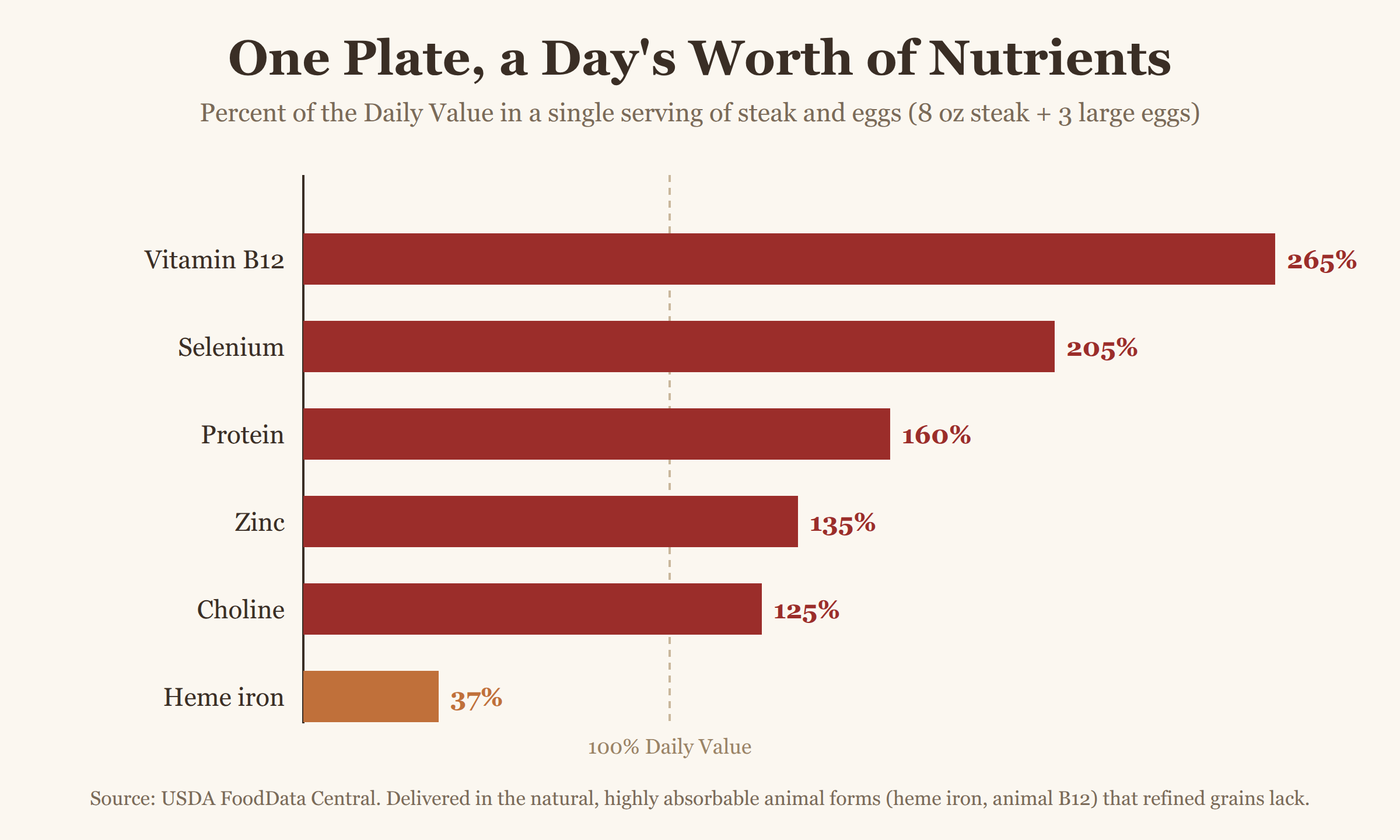
A single serving, something like an eight ounce steak with three eggs, gives you a large dose of complete protein with all nine essential amino acids, the kind of protein that builds and repairs muscle, bone, and every tissue you have. That alone makes it a worthy breakfast. But the protein is only the beginning.
Here is the part the cereal aisle will never print on the box. The most valuable nutrients in this meal are exactly the ones that are scarce, poorly absorbed, or simply absent in plant foods.
The nutrients you cannot get from a cereal box
- Vitamin B12. Beef and eggs together hand you well over a full day's worth of B12 in one sitting, often several times over. This nutrient is essential for your nerves, your blood, and your energy, and it exists in meaningful, usable amounts only in animal foods.
- Heme iron. The iron in red meat is heme iron, the form your body absorbs far more easily than the iron in plants. This is the difference between iron you can read about and iron you can actually use.
- Zinc and selenium. A steak supplies well over a full day of each, and the animal protein around them actually helps you absorb the zinc, rather than locking it away the way the anti-nutrients in grains and legumes do.
- Choline. Each egg yolk carries about 147 milligrams of choline, so three of them deliver most of a day's worth, a nutrient critical for your brain and liver that most people quietly fail to get enough of. The yolk is one of the richest sources on earth, which is exactly why the old advice to throw it away was so backwards.
- Preformed vitamin A and vitamin K2. Egg yolks and real butter, especially from pastured animals, carry vitamin A in its ready-to-use retinol form and vitamin K2, a fat-soluble vitamin with no plant source at all.
- Creatine, carnitine, and taurine. Compounds that fuel your muscles and brain, abundant in meat and eggs, and effectively absent from plants.
There is a reason your body absorbs all of this so well. The fat in the meal is not the enemy the way you were taught. It is the delivery system. The fat-soluble vitamins in that butter and those yolks need fat to be absorbed, which is one more reason the traditional plate was built the way it was. This is the heart of the foundations of health: real food, eaten whole, in the company of the fat that helps you use it. It is also why proper digestion of our food, especially fats matters so much to whether you actually benefit from a meal like this.
But what about cholesterol?
Here is the question that has scared people away from this plate for two generations. The short answer is that the fear was overblown, and the people who write the rules have quietly admitted it.
In its 2015 to 2020 edition, the official Dietary Guidelines for Americans dropped the old 300 milligram daily cholesterol limit entirely. The same authorities who spent decades scaring you away from eggs quietly removed the cap, because the evidence never supported it in the first place. For most people, the cholesterol you eat has only a modest effect on the cholesterol in your blood. Your liver makes most of it, and it simply adjusts to what arrives on your fork.
That is the headline, and for the purposes of your breakfast it is enough: the official reason you were told to fear steak and eggs has already been walked back. The fuller story, the saturated fat question, the diet-heart hypothesis, and what the research actually shows, deserves its own post, and I will give it the full treatment it deserves in the cholesterol myth.
But doesn't red meat shorten your life?
The other half of the fear is that the meat itself, not just the fat in it, is quietly killing you. It is the same story with the same holes. The studies that started the panic were observational and American, watching people who ate the most red meat in an era when they had been told not to, the very people who also tended to smoke more, move less, and live on sugar and processed food. Look at populations without that baggage and the danger evaporates: the PURE study across 18 countries found no link between unprocessed red meat and death or heart disease, and a string of larger analyses since have reached the same weak verdict. Where harm does turn up, it clusters around processed meat, the hot dogs and deli slices, not a real steak. I lay the whole case out in does red meat really shorten your life?.
Choosing and cooking it
Not all steak and eggs is equal, and this is where you can make a good meal even better.
The meat. Grass-fed and grass-finished beef carries more omega-3 fats, more CLA, and more fat-soluble antioxidants like vitamin E than grain-fed beef. If you can find it and afford it, it is the better choice. But do not let perfect be the enemy of good. Conventional beef still delivers essentially the same core nutrients in abundance. A regular steak is still real food.
The eggs. Pastured eggs from hens that actually see the sun can carry several times more vitamin D, roughly twice the vitamin E, and far more omega-3 than eggs from caged hens. The difference is real. Buy pastured when you can.
The fat. Cook in butter, ghee, or tallow, the stable traditional fats our great-grandmothers used. They handle heat well and add their own vitamins A and K2. Leave the industrial seed oils in the cabinet, or better yet, out of the house.
A word of honesty
This is not medical advice, and steak and eggs is not a cure for anything. If you carry the iron-overload condition hemochromatosis, the highly absorbable iron in red meat is a genuine reason to be careful. If you are prone to gout, the purines in red meat may warrant moderation. And if you have a specific condition, work with someone who knows your body, not a headline. You are the one who gets to decide what goes on your plate, and you should make that decision with real information, not inherited fear.
For nearly everyone else, this is simply one of the most nourishing breakfasts you can eat.
Follow the wisdom of the ancients
Our great-grandparents did not have nutrient databases. They had never heard of choline, or B12, or vitamin K2. They simply knew that a plate of meat and eggs and butter made strong children and capable adults, and they ate it without a shred of guilt. Then we got clever, traded it for a box of grain, and got sicker.
The good news is that nothing was lost. The food is still here, the butter is still in the store, and the cast iron pan is still on the shelf. Cook the steak. Fry the eggs in butter. Feed it to your family. Follow the wisdom of the ancients.
Sources
- U.S. Department of Agriculture and U.S. Department of Health and Human Services. Dietary Guidelines for Americans, 2015 to 2020. The 300 mg/day dietary cholesterol limit was removed, and cholesterol was described as "not a nutrient of concern for overconsumption."
- U.S. Senate Select Committee on Nutrition and Human Needs. Dietary Goals for the United States, 1977 (the recommendation to limit cholesterol to under 300 mg/day).
- Kühn J., Schutkowski A., Kluge H., Hirche F., Stangl G.I. Free-range farming: a natural alternative to produce vitamin D-enriched eggs. Nutrition, 2014; 30(4):481 to 484. Egg-yolk vitamin D was three to four times higher in hens with sunlight access.
- Karsten H.D., Patterson P.H., Stout R., Crews G. Vitamins A, E and fatty acid composition of the eggs of caged hens and pastured hens. Renewable Agriculture and Food Systems, 2010; 25(1):45 to 54. Pastured hens' eggs had twice the vitamin E and more than double the omega-3 fatty acids of caged hens' eggs.
- Daley C.A., Abbott A., Doyle P.S., Nader G.A., Larson S. A review of fatty acid profiles and antioxidant content in grass-fed and grain-fed beef. Nutrition Journal, 2010; 9:10. Grass-fed beef carries more omega-3 fats, more CLA, and more antioxidants such as vitamin E.
- USDA FoodData Central and the USDA Database for the Choline Content of Common Foods (choline at about 147 mg per large egg; B12, zinc, selenium, and iron values for beef and eggs).
- NASA and contemporaneous press accounts of Alan Shepard's preflight breakfast, May 5, 1961, and the Apollo 11 crew breakfast, July 16, 1969.