The Vegetable Oil Fraud: How an Industrial Product Became Health Food
Short answer: The vegetable oils sold as heart-healthy, canola, soybean, corn, and sunflower, began as industrial products, not food. They were rebranded over the last century, replacing the stable animal and fruit fats humans had always cooked with. Here is how that switch happened and why it matters.
For almost all of human history, the fat in your kitchen came from an animal you could name or a fruit you could hold. Butter from cream. Lard from a pig. Tallow from a cow. Olive oil from a pressed olive. You knew what it was, because you could have watched it being made.
Then, in about the span of a single lifetime, that changed. The fats our great-grandparents cooked with were pushed off the shelf and replaced by something genuinely new: a pale, odorless oil poured from a bottle, pressed from seeds that give up their oil only under industrial pressure and chemistry, in a refined form no traditional kitchen had ever cooked with, produced by a process almost no one who buys it has ever seen. We were told this was the smarter, healthier choice. We were told the old fats would kill us.
This is the story of where that oil actually came from, what is done to it before it reaches you, and what the honest science says once you strip away the marketing on both sides.
The fat your great-grandparents knew
Picture a kitchen in 1880. The fat on the stove was rendered or pressed, one short step from the animal or the tree it came from. Butter was churned cream. Lard and tallow were fat gently cooked down from the animal. Olive oil was crushed fruit. None of it required a chemist, a solvent, or a factory. A child could understand how it was made.
There was no corn oil in that kitchen, no soybean oil, no canola. Not because those people were pure or wise, but because those oils did not yet exist as food. The seeds they come from give up their oil only under industrial pressure and chemistry that had not been invented yet. When you hear that our ancestors ate "vegetable oil," remember that the bottle in your pantry is younger than the automobile.
So where did the old fats go, and what took their place?
From the factory floor to the frying pan
The honest history of these oils is not a wellness rumor. It is a matter of record, and it is stranger than the rumor.
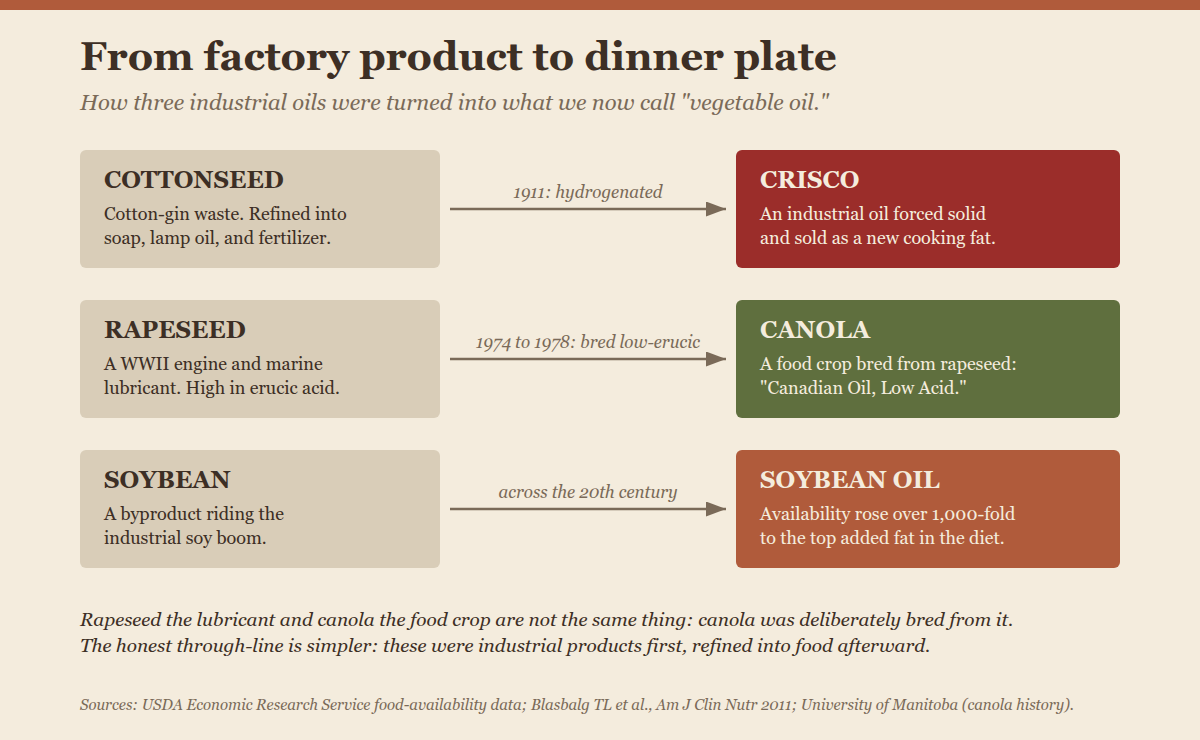
Start with cottonseed. In the 1800s, cottonseed was a near-worthless byproduct of the cotton gin, so abundant and so useless that much of it was simply discarded. The raw seed even carries a natural toxin called gossypol, which has to be refined out. What industry found was that you could squeeze an oil from it and use that oil for lamp fuel, for soap, and for fertilizer. Then, in June of 1911, Procter and Gamble did something clever. They took that cottonseed oil, forced it solid through a chemical process called hydrogenation, and sold it as a brand new cooking fat called Crisco, complete with free cookbooks in which every recipe called for it. An industrial oil had been taught to imitate lard.
Then there is rapeseed, the plant behind canola. Here I want to be careful, because this is where the internet gets the story wrong. Rapeseed oil really was an industrial lubricant. It clung well to metal that steam and water washed over, and demand for it surged during the Second World War to grease marine and ship engines. But natural rapeseed oil was high in erucic acid, a compound flagged as a health concern, so you could not simply pour the engine oil onto a salad. What actually happened is that Canadian plant breeders in the 1970s deliberately bred a new, low-erucic variety fit for eating. The first such cultivar, Tower, was released in 1974, and the food oil was trademarked in 1978 under a coined name: canola, from "Canadian Oil, Low Acid."
So the accurate line is not "canola is motor oil." That is false, and anyone can check it. The accurate line is quieter and, if anything, more telling: canola is a crop that had to be genetically bred away from its industrial parent before it was fit for the dinner table. It did not arrive as food. It was turned into food.
Soybean oil rounds out the picture, riding the great twentieth-century boom in industrial soy. The through-line across all three is simple and documented. These were industrial products first, refined into food second. They were never the fats of the traditional kitchen.
What actually happens in the factory
Here is the part the label does not show you, and it is worth knowing precisely so you neither shrug it off nor exaggerate it.
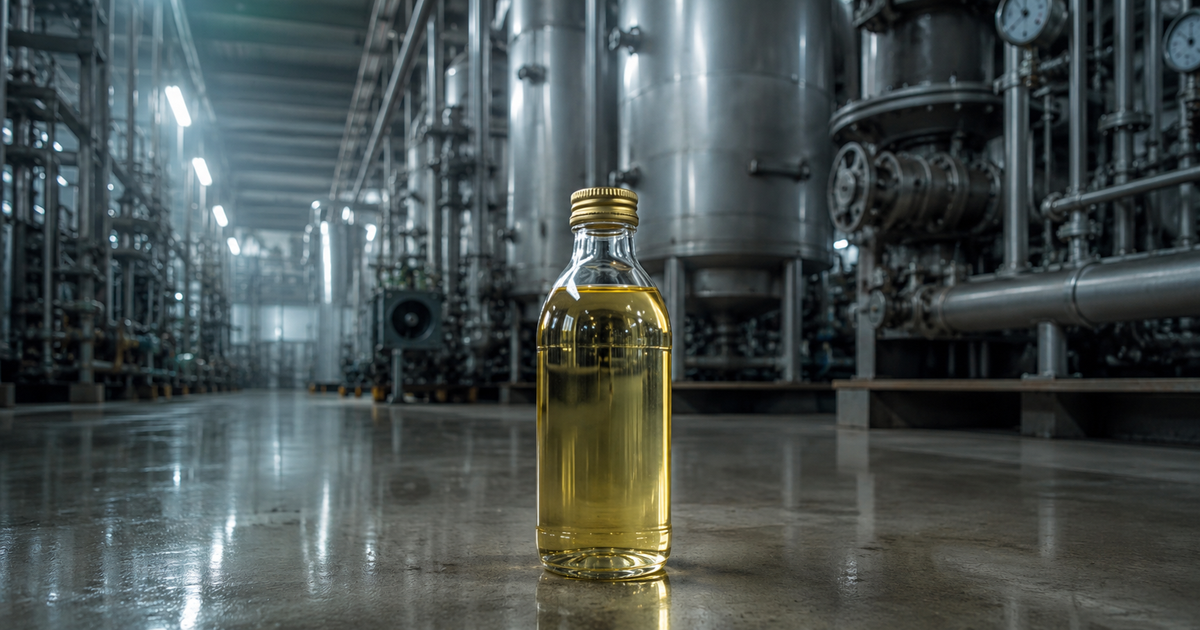
To get the oil out of the seed, the modern process crushes and heats the seed, then washes it with hexane, a solvent derived from petroleum, to pull out the last of the oil. What comes off is then refined, bleached, and deodorized, a sequence the industry itself abbreviates as RBD, much of it under high heat. The deodorizing step exists for a reason: without it, the oil would not smell like something you want to eat.
Now hold that beside how butter is made, which is to agitate cream until it becomes butter, or how good olive oil is made, which is to press the fruit. One of these is a kitchen process. The other is a chemical plant.
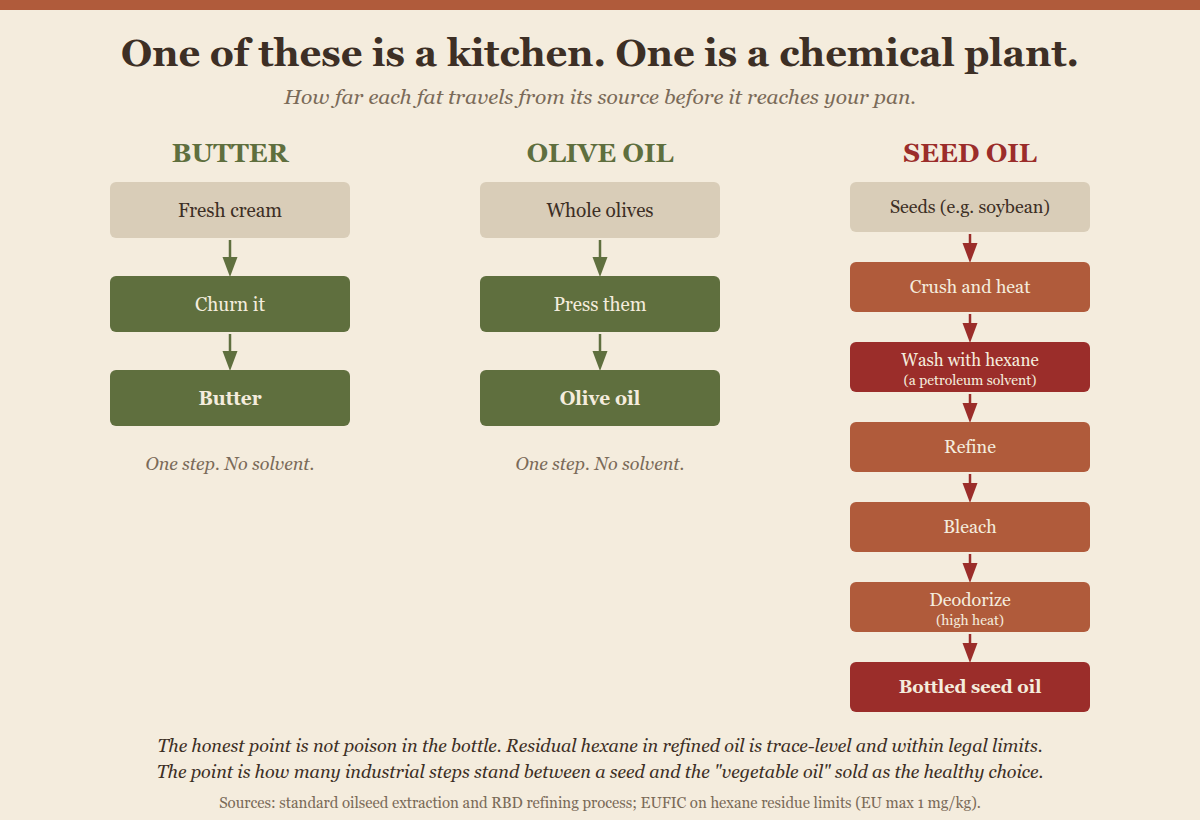
I am not going to tell you the hexane is poisoning you, because the honest evidence does not support that. I am also not going to tell you it's harmless either. Most of the solvent is driven off during refining, and what little may remain is regulated to trace levels, with a legal ceiling in the European Union of one milligram per kilogram. If someone tells you your oil is "full of gasoline," they are overselling. The legitimate point is narrower and still real: this is a fragile fat, pulled from a seed with a petroleum solvent and pushed through high heat and bleaching before it is fit to sell. That matters, but for a different reason, which is what the fat does next.
The fat that will not sit still
The oils we are talking about are rich in a polyunsaturated fat called linoleic acid. Linoleic acid is an omega-6 fatty acid, and here I have to be fair, because fairness is the whole point of this series: linoleic acid is essential. Your body needs some. A small amount, easily supplied by whole foods like nuts, eggs, and meat, is not a problem and never was.
The problem is not the molecule. It is the amount, and the form. Two things happened at once in the twentieth century. First, the quantity exploded. Researchers who reconstructed a century of American eating found that linoleic acid rose from about 2.8 percent of our calories in 1909 to about 7.2 percent by 1999, while the availability of soybean oil specifically rose more than a thousand-fold. We did not nudge this fat upward. We flooded the diet with it.
Second, this particular fat is chemically fragile. Unlike the stable saturated fat in butter and tallow, polyunsaturated fat oxidizes readily under heat, light, and time, which is a plain fact of its chemistry. Here is where I owe you an honest label. The idea that these oxidized fats then drive inflammation and disease in the body is a hypothesis, a well-motivated one, not a settled verdict. What has actually been shown in humans is one careful link in that chain: when researchers lowered the linoleic acid in people's diets, the oxidized linoleic acid byproducts circulating in their blood measurably fell. That connects the diet to the biomarker. It does not, by itself, prove the biomarker causes the disease, and I will not pretend it does.
What happened when they finally tested it
This is where the argument gets real, because it is not a mechanism or a graph. It is the thing itself: controlled trials in which real people replaced saturated fat with seed oil, and researchers counted who lived and who died.
The Minnesota Coronary Experiment fed more than nine thousand people either their usual diet or one in which saturated fat was swapped for corn oil. On paper it worked perfectly. Cholesterol in the corn oil group fell hard, by nearly fourteen percent against almost nothing in the control group. And yet those people did not live longer. When the recovered data were finally analyzed, every thirty point drop in cholesterol was associated with a twenty-two percent higher risk of death, and the harm fell hardest on those over sixty-five. To be precise, that was an association seen across the participants, not a clean difference between the two randomized groups, which did not separate significantly on overall survival. But that is the point: the oil delivered its promise on the cholesterol test and delivered nothing on the graveyard. Most damning of all, the results sat unpublished for roughly forty years, dug out only in 2016 from old magnetic tapes. The experiment that was supposed to crown the theory had quietly buried it.
It was not a fluke. The Sydney Diet Heart Study did much the same thing, replacing saturated fat with safflower oil rich in linoleic acid. When its long-lost data were recovered and published in 2013, the seed oil group had a higher risk of dying, not lower: their all-cause mortality ran about sixty percent higher than the control group, a result sitting right at the edge of statistical significance, its confidence interval just touching the point of no effect, with cardiovascular and coronary death tracking right alongside. Two buried datasets, one uncomfortable direction. The oil moved the number on the cholesterol test. It did not save the people.
Now the honest part, because this is exactly where the establishment stopped being honest with us. These two trials are not the whole literature, and I will not pretend they are. Larger pooled analyses cut the other way. A 2014 review of more than three hundred thousand people found linoleic acid was, if anything, associated with slightly less heart disease, and a 2020 Cochrane review concluded that swapping saturated fat for these oils modestly reduced non-fatal heart events while doing nothing for how long people lived. So I am not going to stand here and tell you seed oils have been proven to kill you. They have not. The evidence is genuinely mixed, and honesty demands saying so plainly. But look carefully at what even the friendliest reading delivers: a smaller number on a cholesterol test, a modest dent in non-fatal events, and no extra years of life. That is a thin, contested benefit. It is nowhere near strong enough to justify what was actually done with it, which was to empty the kitchen of the butter, lard, and tallow that fed people for all of history and replace them with an industrial oil. You do not rebuild the human diet on a maybe.
If this pattern feels familiar, it should. It is the exact story I told in the cholesterol myth: a lab value improved, the marketing declared victory, and the actual human outcome went the other way or nowhere at all.
The graph everyone points to, and what it can and cannot say
You have probably seen the chart. One line shows seed oil consumption climbing through the twentieth century. Another shows obesity, or heart disease, or diabetes, climbing right along with it. The two curves rise together so neatly that the conclusion seems to draw itself.
I am going to do something here that the people who taught us to fear butter never did for us. I am going to tell you exactly what that chart can and cannot prove.
The rise is real. By the government's own food-availability data, soybean oil went from a rounding error in 1909 to a staple, and American adult obesity climbed from about thirteen percent in the early 1960s to about forty percent today. Those are real numbers from real agencies, and I have linked them below so you can see them yourself.
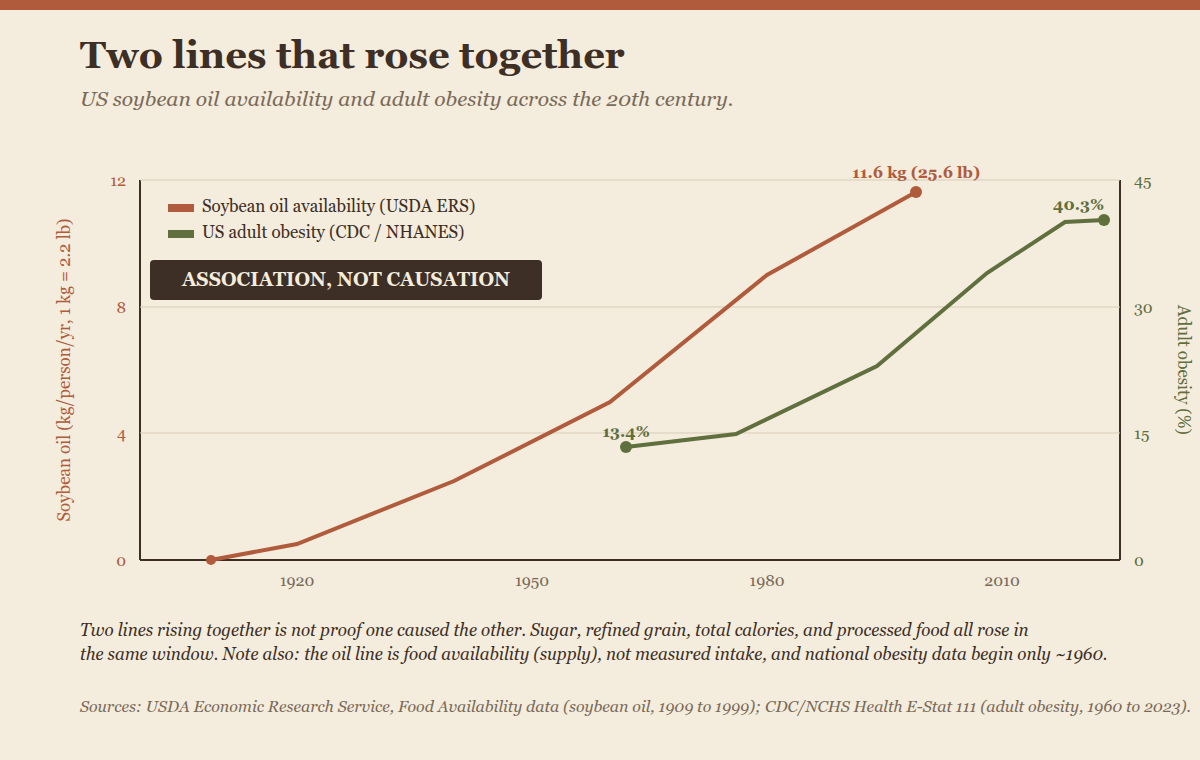
But two honest limits sit on top of that picture. First, the oil figures measure how much was available in the food supply, not how much any person actually ate, and the two are not the same. Second, and this is the one that matters most, a great many other things climbed on that same graph: sugar, refined flour, total calories, ultra-processed food, and a more sedentary life. When everything rises together, a single rising line cannot be crowned the cause. This is precisely the trap Ancel Keys fell into when he drew a tidy line from fat to heart disease across a handful of countries, and I am not going to fall into it in the other direction to score a point. The overlay is a reason to ask hard questions. It is not, on its own, a verdict.
That is the difference between this and the fear you were sold. The case for stepping back from industrial seed oils does not rest on that graph. It rests on the documented history, on a fragile fat pushed to unprecedented levels, and above all on the buried trials that actually counted the bodies.
A word of honesty
This is not a claim that a splash of oil will strike you down, and it is not medical advice. Linoleic acid is essential in small amounts. Whole-food sources of polyunsaturated fat, the nuts and seeds and eggs your great-grandparents ate, are not the total villain here and never were. If you have a specific medical condition, work with a doctor who knows your body (I suggest an ND, not an MD); one blog post does not override your own physician.
What I am asking you to reconsider is narrower and, I think, freeing. The specific thing that is new, industrial, and worth leaving on the shelf is the refined bottle of seed oil, extracted with a petroleum solvent and deodorized so it will sit odorless in your pantry for a year. That is the newcomer. That is the thing your kitchen did fine without for all of history.
Follow the wisdom of the ancients
The fix is older and cheaper than the problem it solves. Cook in butter, in tallow, in lard, in ghee, or in good olive oil kept for lower heat. These are the fats your great-grandmother reached for without a second thought, and she never once read an ingredient label, because real food does not come with one.
Then start reading the labels on everything else, because this is where the oil hides. It is in the salad dressing, the chips, the crackers, the restaurant fryer, the "heart-healthy" spread, nearly everything in the middle aisles of the store. You do not need to be afraid of it. You just need to recognize it for what it is: an industrial product that was sold to you as health food.
Your great-grandmother cooked in butter, and she had never seen a bottle of corn oil, because as food it did not exist yet. It was made in factories, not rendered in kitchens. We are the ones who put it on the plate. We can take it back off.
If you want the fuller picture of what to put on the plate instead, the all-American breakfast they taught us to fear lays out the nourishment waiting in real food, does red meat really shorten your life? takes apart the same weak, confounded science one more time, and the foundations of health ties the whole thing together. Whole food, eaten in a form your body recognizes, has never needed a warning label.
Sources
Every source below is linked so you can read the original for yourself.
- Blasbalg TL, Hibbeln JR, Ramsden CE, Majchrzak SF, Rawlings RR. "Changes in consumption of omega-3 and omega-6 fatty acids in the United States during the 20th century." American Journal of Clinical Nutrition, 2011; 93(5):950 to 962. Dietary linoleic acid rose from 2.79 percent to 7.21 percent of energy from 1909 to 1999; per capita soybean oil availability rose 1,163-fold. https://doi.org/10.3945/ajcn.110.006643 (free full text: https://pmc.ncbi.nlm.nih.gov/articles/PMC3076650/)
- Ramsden CE, Zamora D, Leelarthaepin B, et al. "Use of dietary linoleic acid for secondary prevention of coronary heart disease and death: evaluation of recovered data from the Sydney Diet Heart Study and updated meta-analysis." BMJ, 2013; 346:e8707. The linoleic-acid (safflower oil) group had higher all-cause mortality (hazard ratio 1.62, 95% confidence interval 1.00 to 2.64), cardiovascular mortality (1.70), and coronary mortality (1.74). https://doi.org/10.1136/bmj.e8707
- Ramsden CE, Zamora D, Majchrzak-Hong S, et al. "Re-evaluation of the traditional diet-heart hypothesis: analysis of recovered data from Minnesota Coronary Experiment (1968-73)." BMJ, 2016; 353:i1246. Replacing saturated fat with linoleic-acid-rich corn oil lowered serum cholesterol but produced no survival benefit; each 30 mg/dL fall in cholesterol was associated with a 22 percent higher risk of death (hazard ratio 1.22), with harm concentrated in those aged 65 and older. Data went unpublished for roughly forty years. https://doi.org/10.1136/bmj.i1246
- Ramsden CE, Ringel A, Feldstein AE, et al. "Lowering dietary linoleic acid reduces bioactive oxidized linoleic acid metabolites in humans." Prostaglandins, Leukotrienes and Essential Fatty Acids, 2012; 87(4-5):135 to 141. Lowering dietary linoleic acid measurably reduced circulating oxidized linoleic acid metabolites (OXLAMs); a diet-to-biomarker link, not proof of disease causation. https://doi.org/10.1016/j.plefa.2012.08.004
- Farvid MS, Ding M, Pan A, et al. "Dietary linoleic acid and risk of coronary heart disease: a systematic review and meta-analysis of prospective cohort studies." Circulation, 2014; 130(18):1568 to 1578. Across more than 300,000 people, higher dietary linoleic acid was associated with a modestly lower risk of coronary heart disease. Cited in the interest of one honest standard: the broader evidence is mixed, not one-sided. https://doi.org/10.1161/CIRCULATIONAHA.114.010236
- Hooper L, Martin N, Jimoh OF, Kirk C, Foster E, Abdelhamid AS. "Reduction in saturated fat intake for cardiovascular disease." Cochrane Database of Systematic Reviews, 2020; CD011737. Cutting saturated fat, largely by replacing it with polyunsaturated vegetable oils, modestly reduced combined cardiovascular events but showed little or no effect on all-cause or cardiovascular mortality. https://doi.org/10.1002/14651858.CD011737.pub3
- United States Department of Agriculture, Economic Research Service. Food Availability (Per Capita) Data System, added fats and oils. The primary supply-side dataset behind the soybean oil figures above. Note: this measures food availability, not measured individual consumption. https://www.ers.usda.gov/data-products/food-availability-per-capita-data-system
- Centers for Disease Control and Prevention, National Center for Health Statistics. Health E-Stat 111, "Prevalence of Overweight, Obesity, and Severe Obesity Among Adults Aged 20 and Over: United States, 1960-1962 Through August 2021-August 2023." Age-adjusted adult obesity rose from 13.4 percent (1960 to 1962) to 40.3 percent (2021 to 2023). https://www.cdc.gov/nchs/data/hestat/hestat111.pdf
- History of cottonseed oil and Crisco: cottonseed as a cotton-gin byproduct, gossypol in the raw seed, early use for lamp oil, soap, and fertilizer, and Procter and Gamble's 1911 introduction of Crisco via hydrogenation. https://en.wikipedia.org/wiki/Cottonseed_oil
- History of rapeseed and canola: rapeseed oil's industrial and wartime marine-engine lubricant use, its high erucic acid content, the 1970s Canadian breeding of low-erucic varieties (the "Tower" cultivar, 1974), and the 1978 coining of "canola" from "Canadian Oil, Low Acid." University of Manitoba: https://news.umanitoba.ca/ums-gift-to-the-world-canola/ and https://en.wikipedia.org/wiki/Rapeseed_oil . Fact-check clarifying that canola, unlike its parent rapeseed, was not developed as an engine lubricant: https://leadstories.com/hoax-alert/2024/05/fact-check-canola-oil-was-not-first-developed-as-engine-lubricant-during-ww2.html
- Hexane solvent extraction and RBD (refining, bleaching, deodorizing) as the standard industrial method for seed oils, and the trace, regulated levels of residual hexane in refined oil (European Union limit of 1 mg/kg). European Food Information Council: https://www.eufic.org/en/misinformation/article/is-hexane-in-food-a-cause-for-concern