Tallow Is Back: Why Your Great-Grandmother Cooked With It
Walk into a kitchen from a hundred years ago and look at what is next to the stove. Not a plastic jug of pale yellow oil. A crock of rendered fat. Tallow from beef, lard from pork, butter from the cow, drippings saved from the last roast. For almost all of human cooking history, that is what people fried, roasted, and baked in, and nobody thought it was killing them.
Then, within a couple of generations, it vanished. Tallow went from the most ordinary thing in the house to something a little embarrassing, a relic of a less enlightened time, the kind of fat you were now supposed to know better than to use. In its place came the "heart healthy" vegetable oils, and the story hardened into common sense: animal fat clogs you up, plant oil sets you free.
Now the wheel is turning back. Tallow is showing up again, in home kitchens, in restaurants, even in the fryers of fast-food chains that spent decades running from it. So it is worth asking the honest question. Was tallow ever actually the villain? Or did we exile a perfectly good, ancient food on the strength of a story that has since quietly fallen apart?
Full disclosure before I go further: tallow and ghee are my own two everyday cooking fats, and I also make soap from tallow. So I am not a neutral party. But I am going to hold this to the same single standard I hold everything on this site, including the parts that flatter my own kitchen.
What tallow actually is
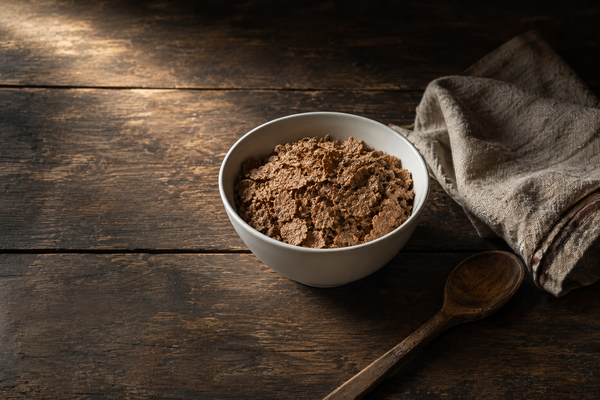
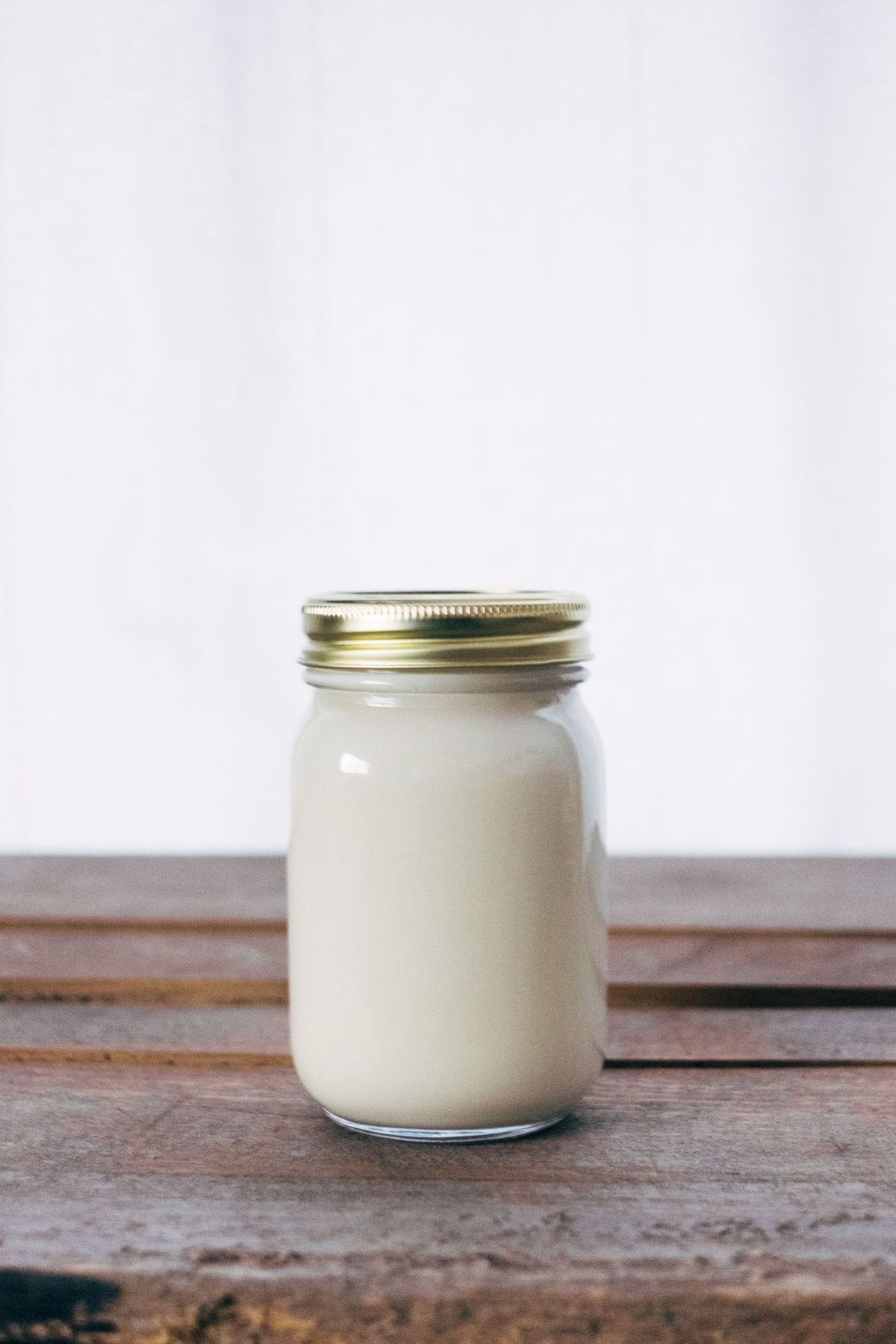
Tallow is just rendered beef fat. You take the fat, warm it gently until it melts and separates from any remaining meat and connective tissue, strain it, and let it set. What you get is a firm, cream-colored fat that keeps for a long time without refrigeration and does not need a laboratory to make. People have been doing this for as long as people have been cooking animals.
What is in it matters for the rest of the story, so here are the actual numbers. According to the USDA's own food composition data, beef tallow is about 50 percent saturated fat and about 42 percent monounsaturated fat, the same family of fat that makes up most of olive oil, with only about 4 percent polyunsaturated fat. Ghee, my other staple, is clarified butter with the milk solids removed, and it is even more saturated, around 62 percent, with likewise very little polyunsaturated fat.
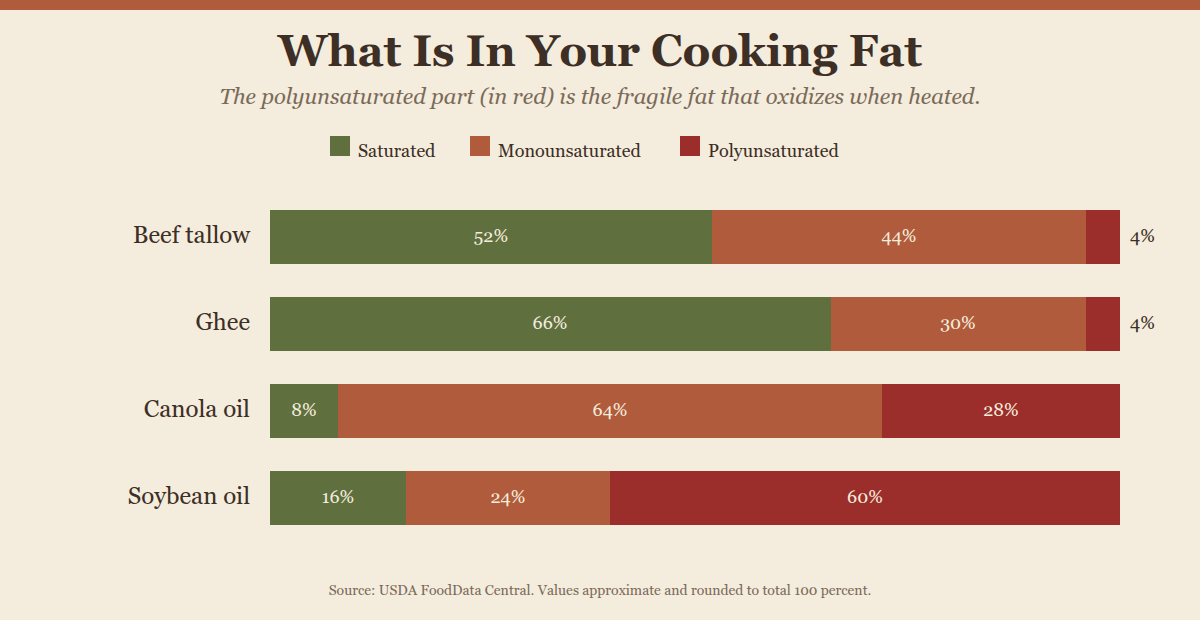
Hold onto that last figure, the low polyunsaturated number, because it turns out to be the whole practical case for cooking with these fats.
How tallow got exiled
For most of American history, the fat in the pan was animal fat or butter. The turn began with a product, not a discovery. In 1911, Procter and Gamble introduced Crisco, the first shortening made entirely from a formerly liquid plant oil, cottonseed oil, hardened by a new industrial process called hydrogenation. It was cheap, it was shelf-stable, and it was marketed brilliantly as the modern, clean, scientific alternative to old-fashioned lard. That is the moment the industrial vegetable fat walked into the American kitchen.
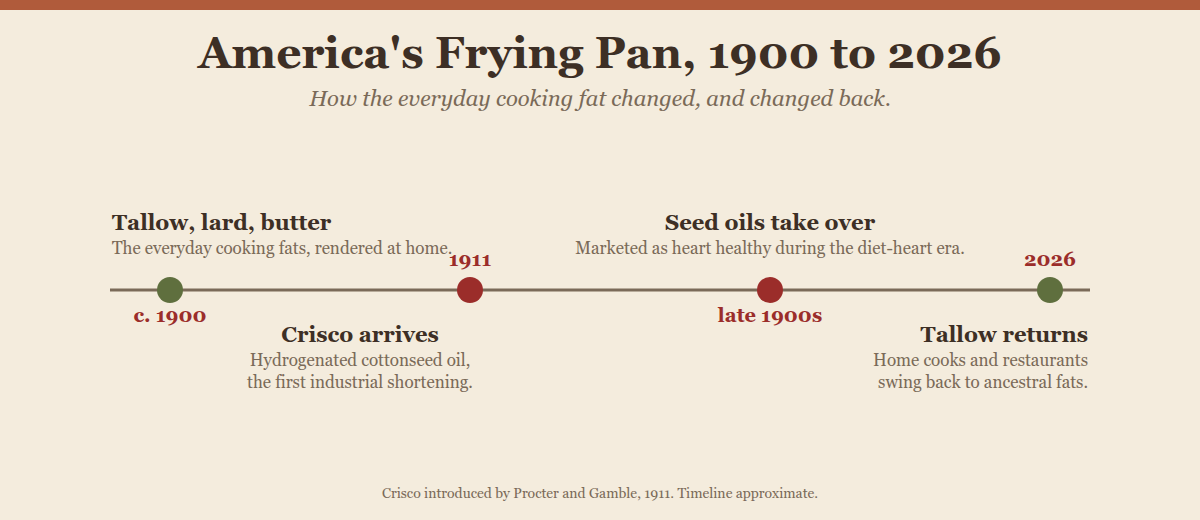
It did not replace tallow overnight. The shift played out over decades, and it got its moral force later, from the diet-heart hypothesis: the mid-century idea that saturated fat raises cholesterol, and cholesterol causes heart disease, therefore the saturated animal fats had to go. I have written about how shaky that chain of reasoning was in the cholesterol piece and about the industry that grew up around the replacements in the vegetable oil piece. The short version is that tallow was not convicted on a careful trial. It was convicted on a hypothesis, and the hypothesis was backed by an industry that had a much cheaper product to sell you.
The honest case for tallow over seed oils
Here is where I have to be careful, because it would be easy to overclaim, and overclaiming is exactly what got us into this mess the first time.
There is one genuinely solid, testable reason to prefer tallow and ghee over polyunsaturated seed oils for cooking, and it is not a mystical one. It is chemistry, and it comes back to that polyunsaturated number. Polyunsaturated fats are chemically fragile. Heat them up in a pan, and they oxidize, breaking down into reactive compounds called aldehydes. Saturated and monounsaturated fats, the kind that dominate tallow and ghee, are far more stable under heat and produce far fewer of these compounds.
This is not a fringe claim. A team led by the chemist Martin Grootveld measured it directly: they fried food in various oils and found that the polyunsaturated-rich ones, like corn and sunflower oil, generated high levels of toxic aldehydes when heated, while more saturated and monounsaturated fats resisted it. The same group has challenged the wisdom of recommending fragile polyunsaturated oils for high-heat frying at all.
Now the honest caveat, held to the same ruler I use everywhere. This evidence is strong on the chemistry. It clearly shows that heated seed oils produce more of these reactive aldehyde compounds, and that those compounds are toxic in laboratory and cell studies. What it does not yet show is that cooking with seed oils at home, at normal exposures, is a proven cause of heart disease or cancer in actual people. There is no randomized human trial nailing that down. So the fair statement is this: tallow and ghee are the more heat-stable, chemically conservative choice for a hot pan, and there is a real mechanistic reason to prefer them. I am not going to tell you seed oils are proven to be poisoning you, because that has not been demonstrated, and you have my word I will not sell you a fear I cannot back.
Now turn the same ruler on tallow
If I am going to demand rigorous evidence before condemning seed oils, I have to demand exactly the same before crowning tallow. And this is where a lot of the current tallow enthusiasm gets ahead of itself.
Start with the thing tallow was supposedly guilty of: its saturated fat causing heart disease. When researchers actually pooled the long-term studies, that case largely dissolved. A 2010 meta-analysis of nearly 350,000 people found no significant association between saturated fat intake and heart disease or stroke. A 2014 review covering hundreds of thousands more reached the same conclusion. A 2015 analysis in the BMJ found saturated fat was not associated with death, cardiovascular disease, or diabetes, though it drew a sharp line and found that industrial trans fats, the hydrogenated kind, genuinely were harmful.
So the charge that tallow's saturated fat is dangerous is much weaker than you were told for fifty years. That is real, and it is why the exile was unjust.
But notice what those studies do and do not say. They say the link between saturated fat and heart disease is weak and uncertain, not that saturated fat is protective, and certainly not that tallow is a superfood you should eat by the spoonful. The evidence exonerates tallow. It does not sanctify it. If I let the pendulum swing from "animal fat will kill you" all the way to "animal fat will heal you," I have just made the exact same mistake in the other direction, trading one overclaim for its mirror image. Tallow is a good, stable, traditional cooking fat. That is the honest ceiling, and it is enough.
Beyond the frying pan
Tallow's ancestral life was never limited to food, and this is the part I know with my own hands. Rendered fat was one of the most useful substances a household had. It was skin salve, candle, lamp fuel, and above all soap.
I make soap from tallow and coconut oil, and the two do different jobs. Coconut oil brings the hard bar and the quick lather. Tallow brings body and a mild, conditioning quality, which is exactly why it was the backbone of soap for centuries before anyone could buy a bottle of anything. When you see the word "sodium tallowate" on an old-fashioned bar of soap, that is precisely what it is: tallow turned to soap. There is something clarifying about making it yourself. You realize this fat was never exotic or dangerous. It was one of the most ordinary, versatile things in a working kitchen.
I will keep this part honest too. Homemade tallow soap cleans and it is pleasant on skin, and that is all I am claiming for it. It is a nice thing to make, not a cure for anything, and I am not going to pretend otherwise.
How to actually use it
If you want to cook with it, a few practical notes.
Tallow has a high smoke point, commonly reported somewhere in the range of 200 to 250 C, roughly 400 to 480 F, with ghee similar or a touch higher. The exact number varies a fair amount depending on how pure the fat is and how it was rendered, so treat those as a range, not a precise line. In practice, both handle high-heat searing, roasting, and frying comfortably, which is exactly where you least want a fragile oil.
For sourcing, tallow from grass-fed beef is the nicer product if you can get it, and you can render your own from beef fat trim quite easily on the stovetop or in a slow cooker. Stored in a sealed jar, it keeps for months. Ghee you can buy ready-made or make from good butter by simmering off the water and straining out the milk solids, which also makes it friendlier for people who do not tolerate dairy well.
None of this is complicated. That is rather the point. Your great-grandmother did not have a food chemistry degree, and she cooked in this stuff every day.
So, should you cook with tallow?
Here is where the evidence honestly lands.
Tallow was exiled on a case that has not held up. The saturated fat it was condemned for is not the clear killer it was made out to be, and the industrial oils that replaced it are the more chemically fragile choice for a hot pan, with a real, measured tendency to form reactive compounds when heated. On both counts, the fat your great-grandmother used looks less like a mistake and more like plain good sense.
But the honest verdict stops there, and I want it to. Tallow is not a miracle. It is not going to cure your ailments or melt your fat or add years to your life on its own, and anyone selling it that way is running the identical playbook that sold you the seed oils. What tallow is, and all it needs to be, is a stable, traditional, real-food fat that never deserved its exile. Cook with it. Cook with ghee. Cook with butter and olive oil too, if you like. Eat real fats, the kind people recognized as food for thousands of years, and hold the health claims, in either direction, to a standard you would not be embarrassed by.
That, in the end, is the most ancestral thing about the whole business. People used to just render the fat, keep it by the stove, and cook. They were not afraid of it, and they were not worshipping it either. We could stand to do the same.
The bottom line
I am not paid by anyone selling fat. No affiliate links, no sponsorship. I render my own tallow and I buy my own ghee.
Here is what I actually do, stated plainly.
Ghee is my first choice, tallow second. Ghee has the higher smoke point of the two, it keeps at room temperature, and it works for almost everything I cook. Tallow is right behind it and better for a hard sear. Between them they cover every hot pan in my kitchen.
I stopped cooking with liquid plant oils, and the reason is heat.
Polyunsaturated oils are fragile by construction. Every double bond in the fatty acid chain is a weak point where oxygen can get in, and heat is what opens the door. Put them in a hot pan and they oxidise, breaking apart into aldehydes and other compounds that were never in the bottle you bought. That is rancidity, running on your stovetop in minutes instead of in the cupboard over months.
Saturated and monounsaturated fats have far fewer of those weak points, so they do not do this to anything like the same degree. Tallow and ghee go into a hot pan and come out as tallow and ghee.
If you are cooking hot, cook in a fat that is built to survive it. That is the whole argument, and it stands on its own without any help.
The longer case about what these oils do to people over decades is a separate argument and I have already made it, in The Vegetable Oil Fraud, where the Minnesota Coronary Experiment and the Sydney Diet Heart Study get the room they deserve. This post is about the pan.
So the case for tallow and ghee rests on this: they are stable under heat, they are foods people have recognized as food for thousands of years, and the case that convicted them was weak.
Render the fat. Keep it by the stove. Cook.
This is one person's reading of the evidence and one person's kitchen, not medical advice. If you have a specific condition that affects how you should eat, work it through with a clinician who is looking at you in particular.
Sources
- USDA FoodData Central. "Fat, beef tallow," FDC ID 171400. Search FoodData Central or fetch the record directly at portal-data/external/171400
- USDA FoodData Central. "Butter, Clarified butter (ghee)," FDC ID 171314. Search FoodData Central or fetch the record directly at portal-data/external/171314
- Smithsonian Magazine. "How Crisco Made Americans Believers in Industrial Food."
- Moumtaz S, Percival BC, Parmar D, Grootveld KL, Jansson B, Grootveld M. "Toxic aldehyde generation in and food uptake from culinary oils during frying practices." Scientific Reports 2019;9:4125. Full text
- Grootveld M, et al. "Evidence-Based Challenges to the Continued Recommendation and Use of Peroxidatively-Susceptible Polyunsaturated Fatty Acid-Rich Culinary Oils for High-Temperature Frying Practises." Frontiers in Nutrition 2021;8:711640. Full text
- Siri-Tarino PW, Sun Q, Hu FB, Krauss RM. "Meta-analysis of prospective cohort studies evaluating the association of saturated fat with cardiovascular disease." Am J Clin Nutr 2010;91(3):535-546. PMID 20071648
- Chowdhury R, et al. "Association of dietary, circulating, and supplement fatty acids with coronary risk." Ann Intern Med 2014;160(6):398-406. PMID 24723079
- Ramsden CE, Zamora D, Leelarthaepin B, Majchrzak-Hong SF, et al. "Use of dietary linoleic acid for secondary prevention of coronary heart disease and death: evaluation of recovered data from the Sydney Diet Heart Study and updated meta-analysis." BMJ 2013 Feb 4;346:e8707. PMID 23386268
- Ramsden CE, Zamora D, Majchrzak-Hong S, Faurot KR, et al. "Re-evaluation of the traditional diet-heart hypothesis: analysis of recovered data from Minnesota Coronary Experiment (1968-73)." BMJ 2016 Apr 12;353:i1246. PMID 27071971
- de Souza RJ, Mente A, Maroleanu A, Cozma AI, et al. "Intake of saturated and trans unsaturated fatty acids and risk of all cause mortality, cardiovascular disease, and type 2 diabetes: systematic review and meta-analysis of observational studies." BMJ 2015 Aug 11;351:h3978. PMID 26268692 | full text at BMJ