Are Medical Errors Secretly a Top-Three Killer?

Short answer: Some analyses estimate medical errors rank among the leading causes of death, yet they rarely make headlines. Hospitals save lives in emergencies, but the everyday risk deserves more attention than it gets. Here is what the numbers suggest.
We are taught to think of hospitals and doctors' offices as the safest places to be when something goes wrong with our health. For emergencies and acute injuries, they often are, and we should be grateful for that. But there is a quieter story running underneath modern medicine, one that rarely makes the evening news, and it is worth understanding so you can protect yourself and the people you love.
The first principle of medicine is "First, do no harm." Yet a growing body of research suggests that preventable harm inside the healthcare system is far more common than most people realize. This is not an argument against doctors, and it is certainly not a reason to avoid care you genuinely need. It is an argument for becoming an informed, active participant in your own health rather than a passive passenger.
Let me be clear about something before we go further, because it matters to me. None of this is an attack on the doctors, nurses, and staff who show up every day genuinely wanting to help. The overwhelming majority are dedicated, caring people doing their best inside a structure that often works against them and their patients alike. My disagreement is not personal, and it is not with the individuals. It is with the system itself, one shaped to serve business and government interests more than the person sitting on the exam table. That is what needs to change. A broken system can be reformed without blaming the good people who are doing their best while trapped inside it. The goal is a system that works for the people it is meant to serve.
A problem bigger than most people think
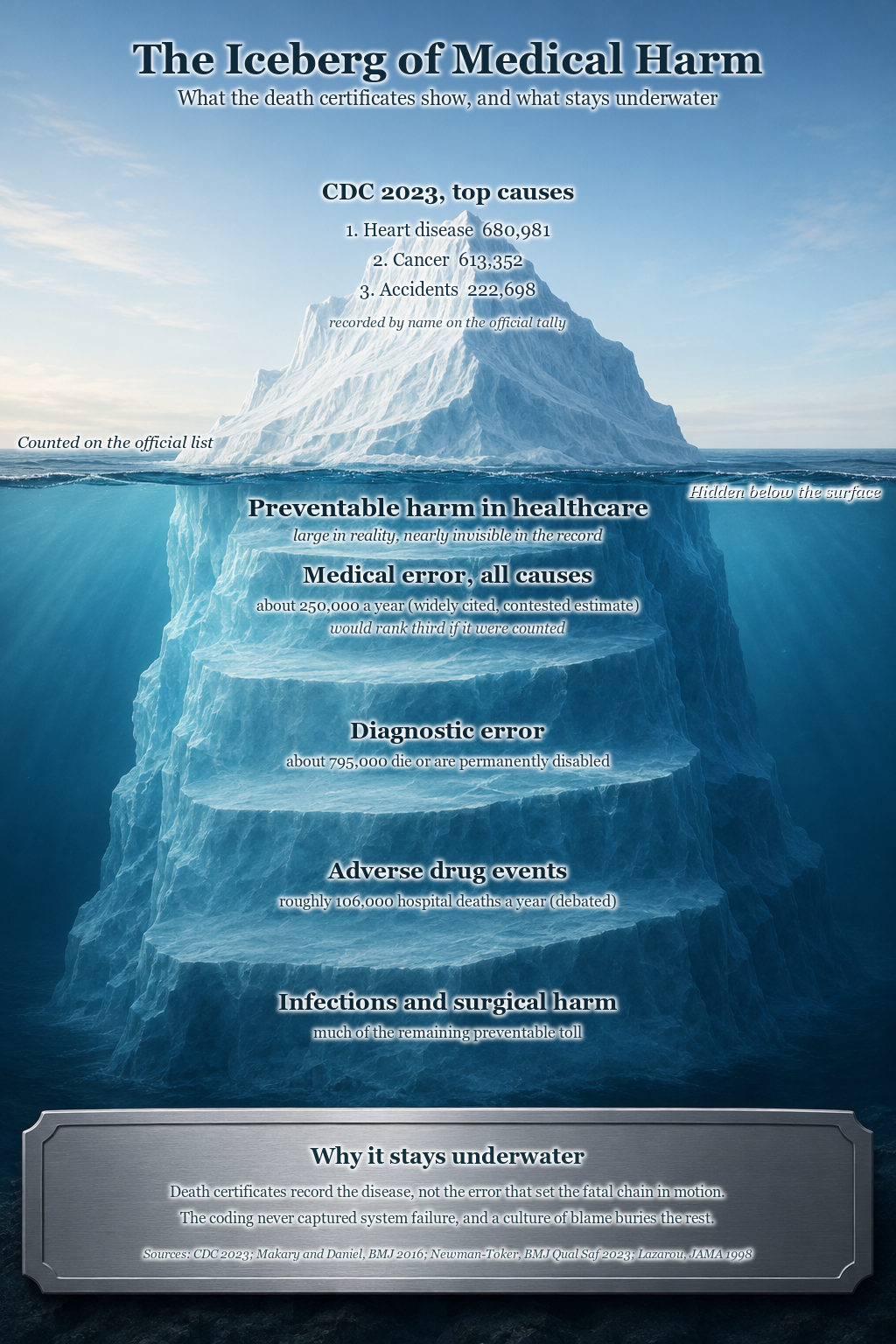
In 2016, two researchers at Johns Hopkins published a widely cited analysis estimating that medical error causes roughly 250,000 deaths a year in the United States, which would place it third on the list of leading causes of death, behind heart disease and cancer. That figure is contested. It was an extrapolation from a handful of studies, and many experts argue the true number is lower or simply unknowable with current data. Even the cautious end of the range, drawn from the landmark report To Err Is Human, put preventable hospital deaths at 44,000 to 98,000 a year. Whichever number is closest to the truth, the honest conclusion is the same. Preventable harm in healthcare is common enough to take seriously.
To see why that claim is so striking, it helps to put the numbers side by side. Here are the official leading causes of death in the United States, with the contested medical errors estimate slotted in where it would fall.
| Rank | Cause of death (US, 2023) | Deaths |
|---|---|---|
| 1 | Heart disease | 680,981 |
| 2 | Cancer | 613,352 |
| (est.) | Medical error (estimate, not on the official list) | ~250,000 |
| 3 | Accidents (unintentional injuries) | 222,698 |
| 4 | Stroke | 162,639 |
| 5 | Chronic lower respiratory diseases | 145,357 |
| 6 | Alzheimer disease | 114,034 |
| 7 | Diabetes | 95,190 |
| 8 | Kidney disease | 55,253 |
| 9 | Chronic liver disease and cirrhosis | 52,222 |
| 10 | COVID-19 | 49,932 |
Official figures are from the CDC for 2023. The medical errors number is a widely cited but contested estimate, and it appears nowhere on the official list for a reason we will come back to: death certificates record the disease, such as sepsis or a heart attack, not the error that set it in motion. If it were counted, it would sit at number three, behind cancer and ahead of accidents.
Medical errors is a broad term. It includes diagnostic failures, surgical mistakes, and adverse drug events, which are harms caused by medications. Each tells part of the story.
The heavy toll of getting the diagnosis wrong
A 2023 study from Johns Hopkins researchers estimated that 795,000 Americans die or are permanently disabled by diagnostic errors each year. That number counts both deaths and lasting disability, not deaths alone, and it is one of the more rigorous estimates we have.
Here is the encouraging part hidden inside that grim figure. The harm is concentrated. Just three categories, vascular events such as strokes, serious infections such as sepsis, and cancers, account for about 75 percent of the most serious harms. In fact, around 15 specific conditions account for roughly half of all serious misdiagnosis-related harm. That concentration matters, because it means this is a focused, solvable problem rather than a vague, hopeless one. Sharpen the diagnosis of a relatively small number of conditions and you prevent a very large share of the damage.
When the treatment becomes the problem
Adverse drug events are their own significant category. A landmark 1998 analysis estimated about 106,000 deaths a year from adverse drug reactions in hospitalized patients, and while estimates vary and the topic is debated, even the conservative numbers are eye opening. These drug related deaths are just one slice of that larger medical error toll. Hospital infections, surgical mistakes, and diagnostic failures make up much of the rest. A few drug classes show up again and again in preventable harm:
- Blood thinners such as warfarin and the newer oral anticoagulants, mainly through serious bleeding.
- Diabetes medications such as insulin and sulfonylureas, which can drive blood sugar dangerously low.
- Opioids, through over sedation, slowed breathing, and accidental overdose.
Older adults carry the highest risk, because they often take many medications at once, process drugs differently, and may not be told what to watch for. This is one of many places where a real-food, root-cause approach earns its keep. When blood sugar, blood pressure, and inflammation are addressed at their source through diet and lifestyle, many people need fewer medications in the first place, and fewer medications means fewer chances for a harmful interaction. If you take anti-inflammatory drugs regularly, our look at how anti-inflammatory drugs actually work explains why the food on your plate can do quiet, steady work that a pill cannot.
Why this crisis stays invisible
If the numbers are this large, why do we hear so little about it? A few reasons.
Death certificates record the physiological cause of death, such as sepsis or a heart attack, not the error that set the fatal chain in motion. The coding systems that generate national statistics were never designed to capture human or system failure. And a culture of blame, where clinicians fear lawsuits and personal shame, leads to massive under reporting. The result is a problem that is enormous in reality but nearly invisible in the official record.
The good news: the power was always in your hands
Here is where I part ways with the usual ending. The hope in this story is not that the system is about to fix itself. Maybe it will, slowly, in places. But you should not have to wait for that, and your health is far too important to hand over and simply hope for the best.
The real hope is this. You have more power than you have been led to believe. We live in the age of information. The same research, guidelines, and second opinions that were once locked inside the profession are now a search away. Yet most of us were raised to outsource our thinking to "the professionals," to go quiet in the exam room and accept whatever we are told. We treat the white coat like a religious garment. It is not one. A good doctor is a highly trained consultant, not a priest, and you are allowed to ask questions, to push back, and to disagree.
My mantra is simple: you are the expert of your own body. No one, including your doctor, knows it better than you do. You are the one living in it every day. You feel what changes, what helps, and what harms. That lived knowledge is real evidence, and it belongs in every decision made about you.
So be skeptical. Ask questions until the answers actually make sense. Look things up. Get the second opinion. None of this means ignoring genuine expertise or stopping a prescribed medication on your own, which you should never do without your doctor's guidance. It means showing up as a partner who has done the homework, not a passenger who signed a blank check. The moment you take that posture, you stop being something the system happens to and become someone it has to answer to.
What you can actually do
You are not powerless here. The single most protective thing you can do is shift from passive patient to active partner. A few simple habits make a real difference:
- Speak up. Ask why a test is being ordered, what a diagnosis is based on, and what else it could be. Good clinicians welcome the questions.
- Do a brown-bag review. Bring everything you take, prescriptions, over-the-counter products, and supplements, to your appointments so interactions can be caught.
- Ask if you still need it. Many medications get started once and then refilled for years without anyone checking whether they still help. Make "can we lower or stop this?" a routine question, and if you get push back, ask for the specific reason and a plan to reassess. Never change a dose on your own, taper only with your doctor's guidance, but do not assume any prescription is meant to be forever.
- Insist on shared decisions. For chronic conditions especially, one-size-fits-all targets can be harmful. Your goals and your biology belong in the conversation.
- Mind the hand-offs. Hospital discharge and transfers between providers are high-risk moments. Ask for a written follow-up plan and a clear point of contact.
- Question aggressive treatment. For older adults, ask whether the "start low and go slow" principle is being followed before any new prescription.
The deeper solution
And notice something before we close. If you have read this far, you are already doing the very thing that protects patients most. Most people never look into any of this. You did. That instinct, to pay attention and ask the next question, is the most powerful safeguard you have, and you are using it right now.
There is also a layer beneath all of this that you control completely. The strongest position to be in is one where you need the system less. A body that is well nourished with real, nutrient-dense food, that sleeps, moves, and manages stress, is more resilient, develops fewer of the chronic conditions that lead to cascades of medications, and heals more readily when it is given what it actually needs. None of this means ignoring genuine medical needs or stopping a prescribed medication on your own, which you should never do without your doctor's guidance. It means building a foundation so sturdy that medicine becomes the backup plan rather than the daily one. That is something you can start building today, one real meal at a time.
Sources
- Makary M, Daniel M. "Medical error-the third leading cause of death in the US." BMJ, 2016.
- Newman-Toker DE, et al. "Burden of serious harms from diagnostic error in the USA." BMJ Quality & Safety, 2023/2024.
- Institute of Medicine. "To Err Is Human: Building a Safer Health System." 1999/2000.
- Mortality in the United States, 2023. CDC, National Center for Health Statistics, Data Brief No. 521.
- Lazarou J, et al. "Incidence of Adverse Drug Reactions in Hospitalized Patients: A Meta-analysis." JAMA, 1998.
- Reducing the Risk of Adverse Drug Events in Older Adults. American Academy of Family Physicians (AAFP).
- National Action Plan for Adverse Drug Event Prevention. Office of the Assistant Secretary for Health.
- Patient Safety. World Health Organization (WHO).