Are Plants Secretly Working Against You? The Truth About Anti-Nutrients
One camp says eat more plants. The other says plants are quietly working against you. The older, calmer answer is more interesting than either.
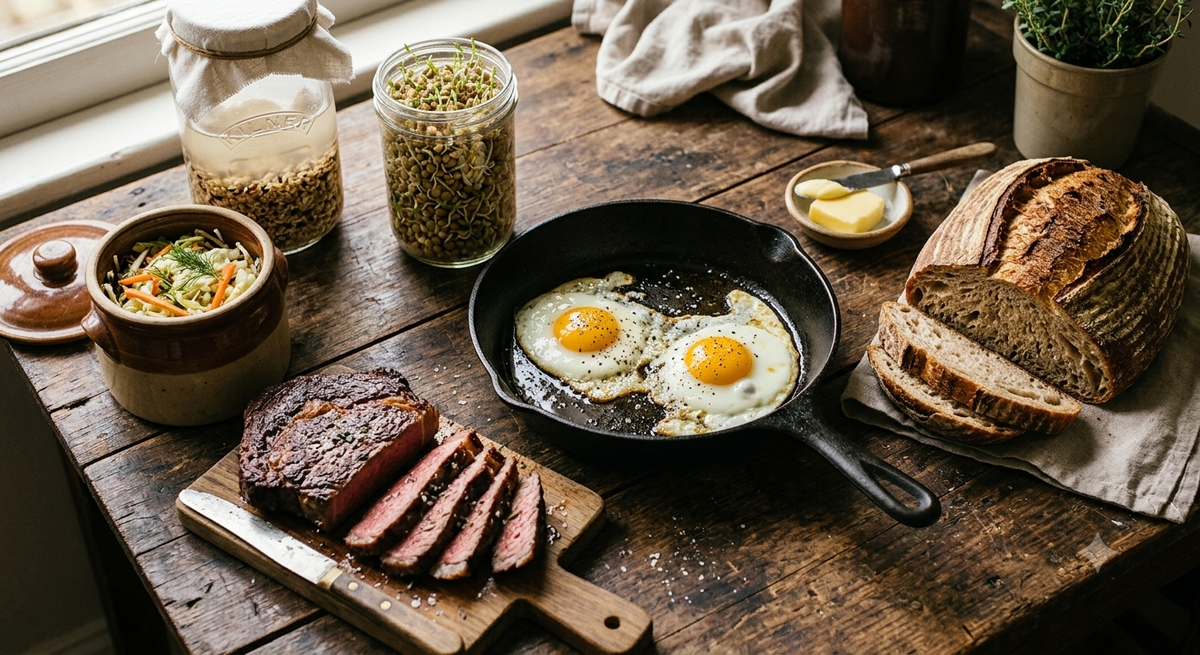
Short answer: Some plants really do carry natural defense compounds, called anti-nutrients, that can block minerals and irritate digestion. That does not make every plant bad, but it is why the advice to just eat more plants is too simple. Here is what they are and simple ways to reduce them.
If you spend any time reading about nutrition, you will eventually run into two big, loud ideas pulling in opposite directions. One camp says plants are the foundation of a healthy diet and you should eat more of them. The other camp says many plants are quietly working against you, loaded with "anti-nutrients" that block minerals and irritate the gut, and that the cleanest path to health is to eat mostly animal foods and leave the plants alone.
Both camps can point to real people who got healthier following their advice. That alone should tell you something important: the answer is probably not a slogan. It is older, quieter, and more interesting than either side lets on. To find it, we have to look at how human beings actually ate for the long stretch of our history, what changed, and what those much-debated anti-nutrients really are once you strip away the fear and the hype.
How our ancestors actually ate
There is a popular image of one single ancestral diet, usually pictured as a caveman gnawing on a leg of meat. The real story is more varied than that. Traditional human diets ranged enormously from place to place and season to season. Some groups ate a great deal of fat and very few carbohydrates. Others ate the opposite. Some leaned heavily on animals, others on plant foods they had learned to prepare with care.
Underneath all that variety, though, a few things held true almost everywhere. Foods were nutrient-dense, seasonal, locally sourced, and minimally processed. Basic preparation techniques were used to make nutrients more available. And no traditional society ate a diet completely free of animal foods.
That last point is not an opinion. It is the central finding of Dr. Weston A. Price, the dentist who traveled the world in the 1930s comparing people still eating their traditional foods to their own relatives who had switched to modern flour, sugar, and processed vegetable oils. Everywhere he looked, the traditional eaters had strong teeth, well-formed faces, and very little of the chronic disease we now call normal. The ones who adopted the modern diet declined within a single generation. Price documented it all in Nutrition and Physical Degeneration. His honest disappointment, stated plainly in his work, was that he could not find a single healthy culture anywhere that ate no animal foods at all.
Price also noticed something that matters for the rest of this article. The healthy traditional diets did not just throw plants in a pot. Their grains, legumes, nuts, and seeds were almost always soaked, sprouted, soured, or fermented before anyone ate them. Our ancestors were not afraid of plant foods. They had simply learned, over thousands of years, how to handle them.
What changed
So how did we drift so far? It happened in stages, and it helps to know them, because each one moved us a little further from the foods our bodies were shaped to use.
The agricultural revolution, roughly ten to twelve thousand years ago, narrowed a wide, varied diet down to a few staple crops. Refined sugar arrived as a luxury in the 1600s and is now eaten by the pound rather than the teaspoon. The industrial revolution pulled people off the land and into cities, where food had to be processed to survive the trip and the shelf, trading nutrient density for convenience. Then came the chemical era after World War II, when wartime production was repurposed into the fertilizers, pesticides, and shelf-stable products that fill most of the grocery store today.
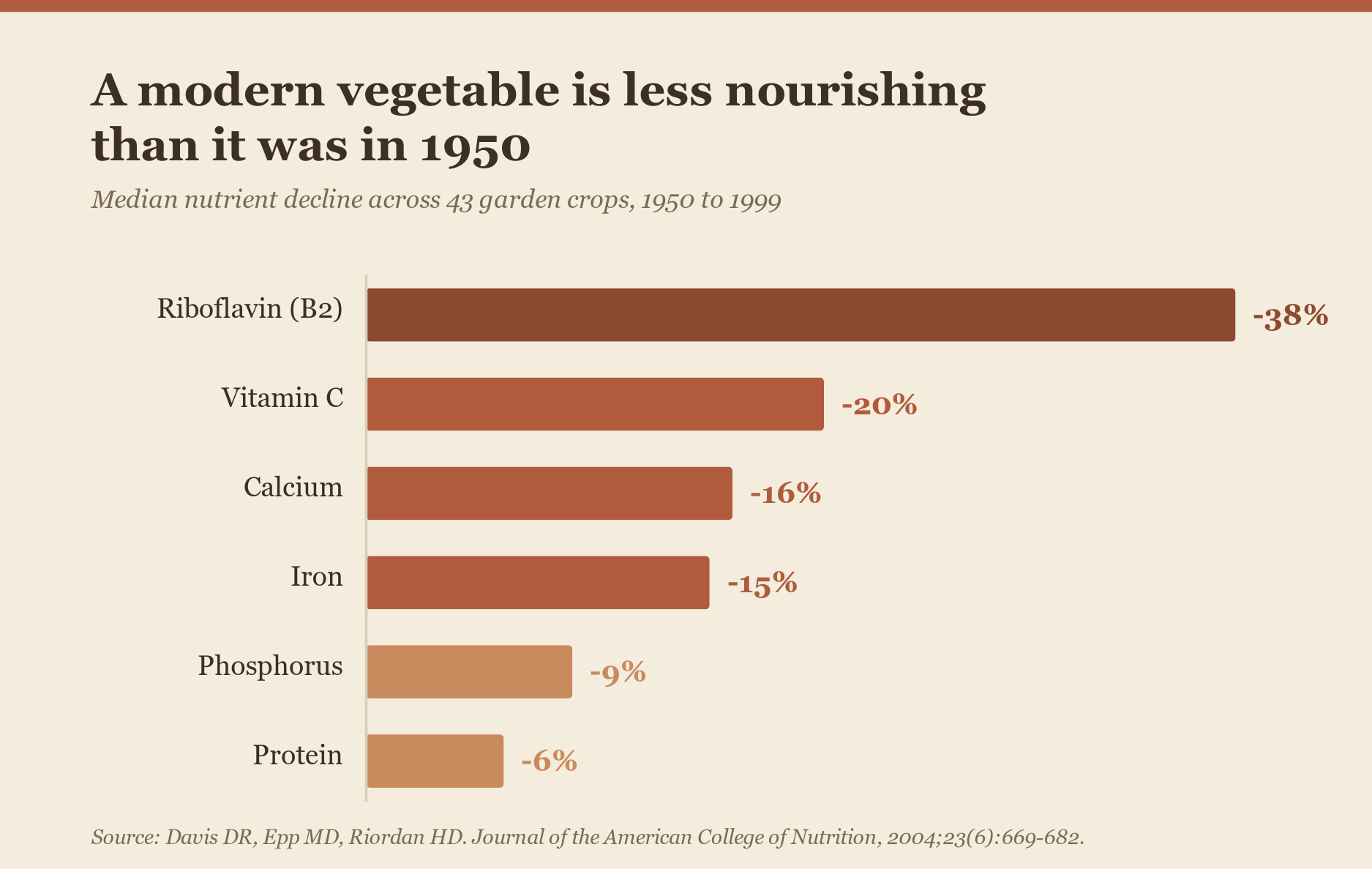
I want to be careful here, because this is where a lot of writing goes off the rails. Agriculture is not evil. It is a choice that came with consequences, and many small local farmers today are working to grow nutrient-dense food in ways that rebuild the soil rather than strip it. The problem is not that humans learned to farm. The problem is what large-scale, corporate, chemical-dependent farming has done to the nutrient content of the food itself. Researchers at the University of Texas, working from decades of USDA data, found reliable declines from 1950 to 1999 in the amounts of protein, calcium, phosphorus, iron, riboflavin, and vitamin C in dozens of common fruits and vegetables. As the lead researcher Donald Davis put it, we have bred crops to grow bigger and faster, but their ability to take up nutrients has not kept pace. A modern vegetable is, quite literally, often less nourishing than the same vegetable was three generations ago.
Anti-nutrients, in plain English
Now to the part everyone argues about. Plants cannot run away from the things that eat them, so over millions of years they developed chemical defenses instead. Some of those compounds are the very things we now call anti-nutrients. The three you hear about most are these.
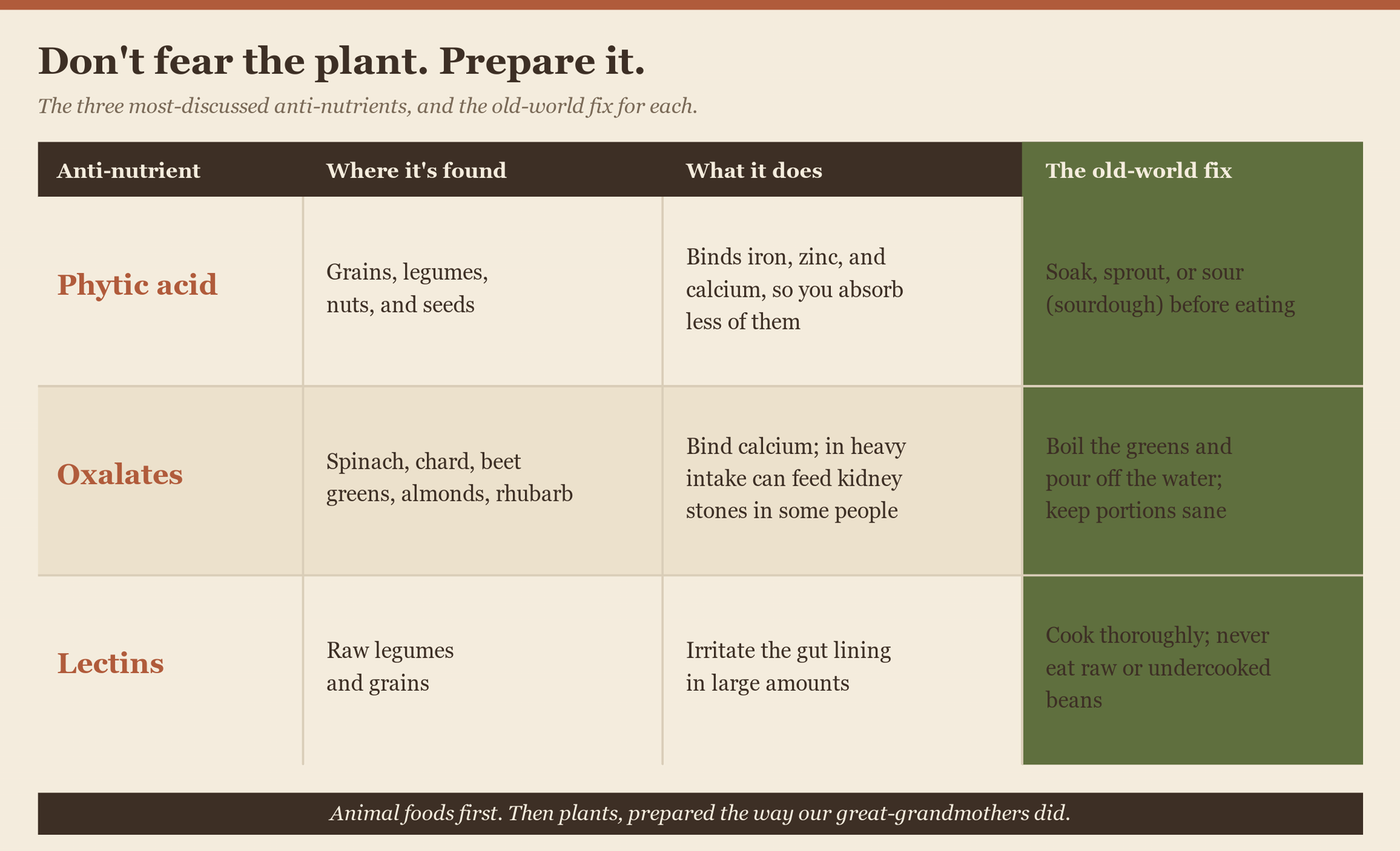
Phytic acid, found in grains, legumes, nuts, and seeds, binds to minerals like iron, zinc, and calcium and can block your body from absorbing them.
Oxalates, concentrated in foods like spinach, chard, beet greens, almonds, and rhubarb, bind to calcium and, in susceptible people and at high enough intake, can contribute to kidney stones.
Lectins, found in raw legumes and grains, can irritate the gut lining in large amounts, which is why eating raw or under cooked beans is a genuinely bad idea.
Here is the part the "plants are perfectly safe" crowd tends to skip. The old principle still holds: the dose makes the poison. These compounds are, quite literally, low-dose plant toxins, chemical defenses a plant evolved so that it would not be eaten, and in the wrong amount, in the wrong body, they cause real trouble. That is not fear-mongering. It is a big part of why so many people feel genuinely better once they remove these foods or prepare them properly. And the three above are only the most talked-about. Others, gluten chief among them, do enough damage to deserve a full post of their own. The ancients had no laboratory and no word for phytic acid, but they understood the danger in their bones, and they met it not with panic but with preparation. So follow the wisdom of the ancients.
The ancestral answer was preparation, not fear
The traditional response to plant defenses was never "panic" and it was never "ignore them." It was to prepare the food. Soaking grains and legumes, sprouting seeds, souring bread with a long sourdough fermentation, and culturing vegetables all sharply reduce phytic acid and other anti-nutrients, and they make the minerals locked inside far more available to your body. Cooking handles most lectins. Simple boiling lowers the oxalate content of many greens.
This is the heart of the real-food, Weston A. Price tradition, and it is worth stating clearly because it gets misrepresented constantly. The traditional view is not "eat all the plants you want." It is closer to this: build the diet on nutrient-dense animal foods first, then add plant foods that have been properly prepared the old way, and feel free to skip the ones that do not agree with you. Animal foods are the foundation. Plants are welcome when they are treated with the respect our great-grandmothers gave them. That is a very different message from "vegetables are toxins," and it is also a very different message from "just eat more salad."
What the evidence actually shows, so you can decide
A fair question at this point is whether the harder claims hold up. If anti-nutrients are real, what happens to people who cut plants out almost entirely, and what happens to people who eat the high-oxalate ones by the bucket? The honest answer is that we have some real evidence, and that evidence is interesting, limited, and worth reading with a clear eye.
On the all-meat side, a 2021 Harvard-affiliated survey published by Lennerz and colleagues followed more than two thousand people eating a carnivore diet and reported high satisfaction and improvements in several self-reported measures. That is real, and it is worth knowing. It is also a survey of people who chose the diet and stuck with it, with no control group, so it tells us that some people feel much better this way. It cannot tell us how a random person would do, or what happens over decades. A small 2024 case series of patients with inflammatory bowel disease using a meat-based, ketogenic approach reported all of them reaching remission. Encouraging, and also tiny and uncontrolled. These are the kinds of results that establish "this can happen and deserves more study," not "this is proven for everyone."
On the other side, the harm from anti-nutrients is also real at the extremes. The medical literature contains case reports of people developing serious kidney damage, called oxalate nephropathy, after going overboard on high-oxalate foods, including one well-documented case tied to eating large amounts of purslane and another linked to an aggressive juice cleanse. The lesson there is not "oxalates will get you." It is that dose matters enormously, and that even a "natural" plant food, eaten in extreme quantity, can cause harm in the wrong body.
Put those two threads together and you get the grown-up version of this whole debate. Some people genuinely thrive eating very few plants. Some people get into trouble eating too many of a particular one. Both can be true at the same time, because people are different.
What my own kitchen taught me
I did not arrive at any of this from a textbook. My mother came to this country as an adult from the Dominican Republic, and she brought her food traditions with her. One of them was saving the fat drippings from whatever animal we cooked, filtering them, and keeping the jar on the counter to cook with the next day. As a teenager I thought it was a little gross, a jar of pale solid fat next to the clean-looking bottle of corn oil. Years later, after I had read enough to be convinced that real animal fats were never the villain, I started saving my own bacon and beef drippings and cooking my eggs in them. It turned out that eating this way was delicious. No cardboard taste. When I finally read Sally Fallon's Nourishing Traditions, I realized my mother had been practicing the same ancestral wisdom the book describes, decades before I had the words for it.
The plant side of my kitchen changed too. I joined a CSA at a small farm twenty minutes from my house, which forced me to learn to cook vegetables I had never seen in a supermarket, grown in living soil and picked days, not weeks, before I ate them. And when my son, who is on the autism spectrum, did better without gluten, I learned to make grain-free versions of the foods we love rather than feed him something that worked against him. None of that is a controlled trial. But your own lived experience is real evidence too, and it belongs in every decision you make about your health.
This is where bio-individuality comes in
If there is one idea that dissolves the whole plants-versus-meat war, it is this one. There is no single diet that is right for every human being. Your genetics, your gut, your blood sugar, your stage of life, and your current state of health all change what serves you best right now. Someone with an autoimmune condition or a damaged gut may do far better with very few plants for a while. Someone with balanced digestion may handle properly prepared grains and a pile of cooked greens beautifully. This is not a cop-out. It is the most accurate thing nutrition can tell you, and it is why I am suspicious of any plan sold as universal.
My mantra is simple, and it fits here perfectly. You are the expert of your own body. No one, including your doctor, knows it better than you do. You are the one living in it. You feel what gives you energy and what leaves you bloated, foggy, or worse. That information is not a distraction from the science. It is data, and it is yours. Listen to your body first and the data second.
Where this leaves you
You do not need to fear your food, and you do not need to swear allegiance to a camp. The path our ancestors walked is calmer and more forgiving than either side of the internet makes it sound. Build your plate on nutrient-dense animal foods. Add plant foods that have been prepared the traditional way, soaked, sprouted, soured, or fermented, so their nutrients are available and their defenses are calmed. Source as much of it as you can from local soil and pasture, where the food still carries the nutrients modern farming has been stripping out. And then pay attention to how you actually feel, and adjust.
None of this means ignoring a real medical need or stopping a prescribed medication on your own, which you should never do without your doctor's guidance. It simply means building a foundation so steady and well-nourished that your body has what it needs to do what it was always designed to do, which is heal and thrive when it is fed well. If digestion is where you struggle, start there, because even the best food does nothing if you cannot break it down and absorb it.
The good news in all of this is that the wisdom was never lost. It was carried in kitchens like my mother's, in local farms that still feed their soil, and in your own body's quiet signals. You can pick it back up starting today, one real, well-prepared meal at a time.
Sources
- Price W. Nutrition and Physical Degeneration. 1939.
- Fallon S, Enig M. Nourishing Traditions. 1999.
- Davis DR, Epp MD, Riordan HD. "Changes in USDA Food Composition Data for 43 Garden Crops, 1950 to 1999." Journal of the American College of Nutrition. 2004;23(6):669-682.
- Taubes G. The Case Against Sugar. 2016.
- Le S. 100 Million Years of Food. 2016.
- Lieberman D. The Story of the Human Body. 2014.
- Lennerz BS, Mey JT, Henn OH, Ludwig DS. "Behavioral Characteristics and Self-Reported Health Status among 2029 Adults Consuming a 'Carnivore Diet.'" Current Developments in Nutrition. 2021;5(12):nzab133.
- Norwitz NG, Soto-Mota A, et al. "Case report: Carnivore-ketogenic diet for the treatment of inflammatory bowel disease: a case series of 10 patients." Frontiers in Nutrition. 2024;11:1467475. (10 patients, uncontrolled; treat as hypothesis-generating.)
- Pottenger FM Jr. "Pottenger's Cats: A Study in Nutrition." 1983. (Animal study; generalize to humans with caution.)
- Yang B, et al. "Purslane-induced oxalate nephropathy: case report and literature review." BMC Nephrology. 2023;24:200. doi:10.1186/s12882-023-03236-9.
- Makkapati S, D'Agati VD, Balsam L. "'Green Smoothie Cleanse' Causing Acute Oxalate Nephropathy." American Journal of Kidney Diseases. 2018;71(2):281-286.
- Nutritional Therapy Association. Evolution of the Modern Diet, Student Guide.